宿の本棚
グリム童話
Household Tales
グリム兄弟(英訳 マーガレット・ハント)
段落の「訳」で日本語が開きます。ゲームの中では、単語に触れると辞書が引けます。
The Frog-King, or Iron Henry
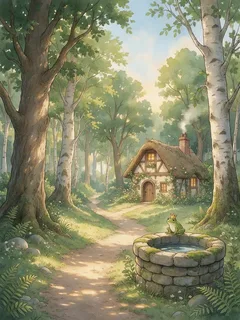
In old times when wishing still helped one, there lived a king whose daughters were all beautiful, but the youngest was so beautiful that the sun itself, which has seen so much, was astonished whenever it shone in her face. Close by the King’s castle lay a great dark forest, and under an old lime-tree in the forest was a well, and when the day was very warm, the King’s child went out into the forest and sat down by the side of the cool fountain, and when she was dull she took a golden ball, and threw it up on high and caught it, and this ball was her favorite plaything.
昔々、願いごとがまだ人の助けになったころ、ある王がいた。娘たちはみな美しかったが、末娘はひときわ美しく、世の中のことをたくさん見てきたはずの太陽でさえ、彼女の顔を照らすたびに驚くほどだった。王の城のすぐ近くには大きな暗い森があり、その森の中の古い菩提樹の下には井戸があった。夏の日差しがたいへん強いとき、王の子どもは森へ出て行って、その涼しい泉のそばに腰を下ろした。また、退屈すると金の球を取り出し、高く放り上げては受けとめた。これが彼女のお気に入りの遊び道具だった。
Now it so happened that on one occasion the princess’s golden ball did not fall into the little hand which she was holding up for it, but on to the ground beyond, and rolled straight into the water. The King’s daughter followed it with her eyes, but it vanished, and the well was deep, so deep that the bottom could not be seen. On this she began to cry, and cried louder and louder, and could not be comforted. And as she thus lamented someone said to her, “What ails thee, King’s daughter? Thou weepest so that even a stone would show pity.” She looked round to the side from whence the voice came, and saw a frog stretching forth its thick, ugly head from the water.
さて、あるときたまたま、王女の金の球は、差し上げていた小さな手の中へは落ちず、その先の地面へ落ちて、まっすぐ水の中へころがり落ちた。王の娘は目でそれを追ったが、球は見えなくなり、井戸はあまりにも深く、底は見えなかった。そこで彼女は泣きだし、いよいよ大きな声で泣き、どうしても慰められなかった。そうして泣きわめいていると、だれかがこう言った。「どうしたのだ、王の娘よ。そんなに泣いては、石でさえ哀れに思うほどだぞ。」彼女が声のしたほうを見回すと、水から太くて醜い頭を突き出した蛙が見えた。
“Ah! old water-splasher, is it thou?” said she; “I am weeping for my golden ball, which has fallen into the well.”
「ああ、古い水はね返しさん、あんただったのね」と彼女は言った。「わたしは、井戸に落ちてしまった金の球のことで泣いているのよ。」
“Be quiet, and do not weep,” answered the frog, “I can help thee, but what wilt thou give me if I bring thy plaything up again?”
「静かにして、お泣きでない」と蛙は答えた。「わたしがお助けしよう。だが、おまえのおもちゃをまた取り上げてきてやるなら、何をくれるのだ。」
“Whatever thou wilt have, dear frog,” said she—“My clothes, my pearls and jewels, and even the golden crown which I am wearing.”
「あなたがほしがるものなら、何でもあげるわ、親切な蛙さん」と彼女は言った。「わたしの着物も、真珠も宝石も、そして、今かぶっている金の王冠だって。」
The frog answered, “I do not care for thy clothes, thy pearls and jewels, or thy golden crown, but if thou wilt love me and let me be thy companion and playfellow, and sit by thee at thy little table, and eat off thy little golden plate, and drink out of thy little cup, and sleep in thy little bed—if thou wilt promise me this I will go down below, and bring thee thy golden ball up again.”
蛙は答えた。「おまえの着物も、真珠や宝石も、金の王冠もいらぬ。だが、もしおまえがわたしを愛し、わたしをおまえの連れであり遊び仲間にし、そばの小さな食卓にわたしをつかせ、小さな金の皿から食べ、小さな盃で飲み、小さな寝台で寝かせるのなら――その約束をするなら、わたしは下へもぐって、おまえの金の球をまた持ってきてやろう。」
“Oh yes,” said she, “I promise thee all thou wishest, if thou wilt but bring me my ball back again.” She, however, thought, “How the silly frog does talk! He lives in the water with the other frogs, and croaks, and can be no companion to any human being!”
「まあ、ええわ」と彼女は言った。「あなたが望むことは、みんな約束するわ。だから、ただ金の球を取り戻してちょうだい。」だが彼女は心の中でこう思った。「なんてばかな蛙なの。ほかの蛙たちといっしょに水に住んで、ゲロゲロ鳴いているだけのくせに、人間のだれかの相手になれるものですか。」
But the frog when he had received this promise, put his head into the water and sank down, and in a short while came swimming up again with the ball in his mouth, and threw it on the grass. The King’s daughter was delighted to see her pretty plaything once more, and picked it up, and ran away with it. “Wait, wait,” said the frog. “Take me with thee. I can’t run as thou canst.” But what did it avail him to scream his croak, croak, after her, as loudly as he could? She did not listen to it, but ran home and soon forgot the poor frog, who was forced to go back into his well again.
しかし、蛙はこの約束を受け取ると、水の中へ頭を入れて沈み、やがてまた少したって、口に球をくわえて泳ぎ上がってきて、それを草の上へ投げた。王の娘は、かわいいおもちゃがまた戻ったのを見て大喜びし、それを拾うと走って行ってしまった。「待って、待って」と蛙が言った。「わたしも連れて行ってくれ。おまえのようには走れないのだ。」だが、あとを追ってできるかぎり大きな声で「ゲロ、ゲロ」と叫んだところで、何の役に立とう。彼女はそれに耳を貸さず、家へ走って帰ってしまい、かわいそうな蛙のことなどすぐに忘れてしまったので、蛙はまた井戸へ戻らざるをえなかった。
The next day when she had seated herself at table with the King and all the courtiers, and was eating from her little golden plate, something came creeping splish splash, splish splash, up the marble staircase, and when it had got to the top, it knocked at the door and cried, “Princess, youngest princess, open the door for me.” She ran to see who was outside, but when she opened the door, there sat the frog in front of it. Then she slammed the door to, in great haste, sat down to dinner again, and was quite frightened.
翌日、彼女が王と廷臣たちみんなとともに食卓について、小さな金の皿から食べていると、何かが、ちゃぷちゃぷ、ぴちゃぴちゃと大理石の階段を這い上がってきた。そして頂上まで来ると、扉を叩いて叫んだ。「王女さま、末の王女さま、どうか戸を開けておくれ。」彼女は外にだれがいるのか見ようと走っていったが、戸を開けると、そこには蛙がすわっていた。そこで彼女はあわてて戸をぴしゃりと閉め、もう一度食事の席についたが、すっかり恐ろしくなっていた。
The King saw plainly that her heart was beating violently, and said, “My child, what art thou so afraid of? Is there perchance a giant outside who wants to carry thee away?”
王は、彼女の胸がひどく高鳴っているのをすぐに見て取って、言った。「わが子よ、何をそんなに怖がっているのだ。もしかして、外におまえをさらっていこうとする巨人でもいるのか。」
“Ah, no,” replied she. “It is no giant but a disgusting frog.”
「ああ、いえ」と彼女は答えた。「巨人なんかじゃなくて、気持ちの悪い蛙なの。」
“What does a frog want with thee?”
「蛙が、おまえに何の用だ。」
“Ah, dear father, yesterday as I was in the forest sitting by the well, playing, my golden ball fell into the water. And because I cried so, the frog brought it out again for me, and because he so insisted, I promised him he should be my companion, but I never thought he would be able to come out of his water! And now he is outside there, and wants to come in to me.”
「ああ、お父さま。きのう、わたしが森の井戸のそばにすわって遊んでいましたら、金の球が水の中へ落ちてしまったのです。それでわたしがあんなに泣いたものだから、蛙がそれをまた取り出してくれました。そして、その蛙がしきりに言い張るものですから、わたしは、あの子をわたしの連れにすると約束してしまいました。でも、あの子がほんとうに水の中から出てこられるなんて、思ってもみなかったのです。ところが今、その子は外にいて、中へ入れてくれと申しているのです。」
In the meantime it knocked a second time, and cried,
そのあいだにも、二度目のノックがあり、こう叫んだ。
“Princess! youngest princess! Open the door for me! Dost thou not know what thou saidst to me Yesterday by the cool waters of the fountain? Princess, youngest princess! Open the door for me!”
「王女さま! 末の王女さま! どうか戸を開けておくれ! おまえは忘れたのかい、 きのう、涼しい泉のそばでわたしに言ったことを? 王女さま! 末の王女さま! どうか戸を開けておくれ!」
Then said the King, “That which thou hast promised must thou perform. Go and let him in.”
それを聞いて王は言った。「約束したことは果たさねばならぬ。行って、入れてやりなさい。」
She went and opened the door, and the frog hopped in and followed her, step by step, to her chair. There he sat and cried, “Lift me up beside thee.” She delayed, until at last the King commanded her to do it. When the frog was once on the chair he wanted to be on the table, and when he was on the table he said, “Now, push thy little golden plate nearer to me that we may eat together.” She did this, but it was easy to see that she did not do it willingly. The frog enjoyed what he ate, but almost every mouthful she took choked her. At length he said, “I have eaten and am satisfied; now I am tired, carry me into thy little room and make thy little silken bed ready, and we will both lie down and go to sleep.”
彼女は行って戸を開けた。すると蛙はぴょんと跳び込み、彼女のあとについて、一歩ずつ椅子のところまで来た。そこで蛙はすわり、「わたしをそばへ持ち上げておくれ」と言った。彼女はぐずぐずしていたが、ついに王がそうするよう命じた。蛙がいったん椅子の上に来ると、今度は食卓に上がりたがり、食卓の上に乗ると、「さあ、小さな金の皿を、いっしょに食べられるように、こっちへ寄せておくれ」と言った。彼女はそうしたが、いやいやそうしたのは見ればすぐわかった。蛙は食べ物をおいしそうに味わったが、彼女のほうは、一口ごとにのどが詰まりそうだった。やがて蛙は言った。「もう食べて満足した。さて、わたしは疲れたぞ。おまえの小さな部屋へ連れて行って、小さな絹の寝台を整えてくれ。そうしたら二人で横になって眠ろう。」
The King’s daughter began to cry, for she was afraid of the cold frog which she did not like to touch, and which was now to sleep in her pretty, clean little bed. But the King grew angry and said, “He who helped thee when thou wert in trouble ought not afterwards to be despised by thee.” So she took hold of the frog with two fingers, carried him upstairs, and put him in a corner.
王の娘は泣きだした。というのも、冷たい蛙に触れるのは怖かったし、あまり好きでもないその蛙が、かわいらしく清潔な小さな寝台で眠ることになったからである。だが王は腹を立てて言った。「おまえが困っているときに助けてくれた者を、あとになって軽んじてはならぬ。」そこで彼女は蛙を二本の指ではさむようにしてつかみ、階段を上って運び、部屋の隅に置いた。
But when she was in bed he crept to her and said, “I am tired, I want to sleep as well as thou, lift me up or I will tell thy father.”
しかし、彼女が寝床に入ると、蛙は彼女のそばへ這ってきて言った。「わたしも眠いのだ。おまえと同じように眠りたい。持ち上げておくれ。さもないと、おまえのお父上に言いつけるぞ。」
Then she was terribly angry, and took him up and threw him with all her might against the wall. “Now, thou wilt be quiet, odious frog,” said she. But when he fell down he was no frog but a King’s son with beautiful kind eyes. He by her father’s will was now her dear companion and husband. Then he told her how he had been bewitched by a wicked witch, and how no one could have delivered him from the well but herself, and that tomorrow they would go together into his kingdom. Then they went to sleep, and next morning when the sun awoke them, a carriage came driving up with eight white horses, which had white ostrich feathers on their heads, and were harnessed with golden chains, and behind stood the young King’s servant Faithful Henry. Faithful Henry had been so unhappy when his master was changed into a frog, that he had caused three iron bands to be laid round his heart, lest it should burst with grief and sadness. The carriage was to conduct the young King into his Kingdom.
すると彼女はひどく腹を立て、彼を抱え上げると、力の限り壁へ投げつけた。「これでおまえは静かになるだろう、忌まわしい蛙め」と彼女は言った。だが彼が落ちてみると、蛙ではなく、美しい、やさしい目をした王子であった。彼は、彼女の父の遺志によって、今や彼女の親しい伴侶であり夫となった。それから彼は、自分が邪悪な魔女に魔法をかけられていたこと、そして自分を井戸から救い出せる者は彼女のほかになかったこと、さらに明日はふたりで自分の王国へ行くのだと彼女に話した。それからふたりは眠りにつき、翌朝、太陽が彼らを目覚めさせると、白いダチョウの羽飾りを頭につけ、金の鎖でつながれた八頭の白馬を曳く馬車がやって来た。その後ろには、若い王の従者である忠実なハインリヒが立っていた。忠実なハインリヒは、主人が蛙に変えられたとき、悲しみのあまり胸が張り裂けそうになり、それを防ぐために心臓のまわりに三つの鉄の輪をはめさせていた。その馬車は、若い王を王国へ連れていくためのものであった。
Faithful Henry helped them both in, and placed himself behind again, and was full of joy because of this deliverance. And when they had driven a part of the way the King’s son heard a cracking behind him as if something had broken. So he turned round and cried, “Henry, the carriage is breaking.”
忠実なハインリヒはふたりを馬車に乗せ、みずからはまた後ろに立った。彼はこの解放を喜びに満ちていた。そうしてしばらく道を進んだとき、王子は後ろで何かが折れたような、ぱきんという音を聞いた。そこで振り向いて叫んだ。「ハインリヒ、馬車が壊れるぞ。」
“No, master, it is not the carriage. It is a band from my heart, which was put there in my great pain when you were a frog and imprisoned in the well.” Again and once again while they were on their way something cracked, and each time the King’s son thought the carriage was breaking; but it was only the bands which were springing from the heart of faithful Henry because his master was set free and was happy.
「いいえ、旦那さま、馬車ではございません。あれは私の心臓に巻かれていた輪のひとつでございます。旦那さまが蛙にされて井戸に閉じ込められておられたとき、私の胸の苦しみのためにそこに付けられたものでございました。」それからまたしばらく行くうちに、またもや、そしてもう一度、何かがぱきりと鳴った。そのたびに王子は馬車が壊れるのだと思ったが、それはただ、主人が解放されて幸福になったので、忠実なハインリヒの心臓から輪がはじけ飛んでいたのである。
The Wolf and the Seven Little Kids
There was once upon a time an old goat who had seven little kids, and loved them with all the love of a mother for her children. One day she wanted to go into the forest and fetch some food. So she called all seven to her and said, “Dear children, I have to go into the forest, be on your guard against the wolf; if he come in, he will devour you all—skin, hair, and all. The wretch often disguises himself, but you will know him at once by his rough voice and his black feet.”
昔々、年老いたやぎがいて、七匹の小やぎたちを持ち、母が子どもを愛するのと同じ心で、彼らを心から愛していた。ある日、彼女は森へ食べ物を取りに行きたくなった。そこで七匹みなを呼び寄せて、こう言った。「かわいい子どもたち、母さんは森へ行かなければなりません。おおかみにはじゅうぶん気をつけるのですよ。あの子が入ってきたら、皮も毛も、何もかも、みんな食べられてしまいますからね。あのろくでなしは、いつもしょっちゅう変装をしますが、あの荒い声と黒い足ですぐにわかりますよ。」
The kids said, “Dear mother, we will take good care of ourselves; you may go away without any anxiety.” Then the old one bleated, and went on her way with an easy mind.
子どもたちは言った。「かわいいお母さん、私たちはちゃんと自分たちの身を守ります。どうぞ心配なさらずにお出かけください。」すると老いたやぎは声を鳴らし、安心しきって出かけていった。
It was not long before someone knocked at the house-door and called, “Open the door, dear children; your mother is here, and has brought something back with her for each of you.”
それからほどなくして、だれかが家の戸をたたき、「戸をお開け、かわいい子どもたち。お母さんが帰ってきたよ。みんなにおみやげも持ってきたのだよ」と呼んだ。
But the little kids knew that it was the wolf, by the rough voice; “We will not open the door,” cried they, “thou art not our mother. She has a soft, pleasant voice, but thy voice is rough; thou art the wolf!”
しかし小やぎたちは、その荒い声で、それがオオカミだとわかった。「戸は開けません」と彼らは叫んだ。「おまえはお母さんじゃない。お母さんの声はやわらかくてやさしいけれど、おまえの声は荒い。おまえはオオカミだ!」
Then the wolf went away to a shopkeeper and bought himself a great lump of chalk, ate this and made his voice soft with it. Then he came back, knocked at the door of the house, and cried, “Open the door, dear children, your mother is here and has brought something back with her for each of you.”
そこでオオカミは店に行って、大きなチョークのかたまりを買い、それを食べて声をやわらげた。それからまた戻って家の戸をたたき、「戸をお開け、かわいい子どもたち。お母さんが帰ってきたよ。みんなにおみやげも持ってきたのだよ」と叫んだ。
But the wolf had laid his black paws against the window, and the children saw them and cried, “We will not open the door, our mother has not black feet like thee; thou art the wolf.”
けれどもオオカミは窓に黒い前足をつけていたので、子どもたちはそれを見て、「戸は開けません。私たちのお母さんは、おまえのように黒い足をしていない。おまえはオオカミだ」と叫んだ。
Then the wolf ran to a baker and said, “I have hurt my feet, rub some dough over them for me.” And when the baker had rubbed his feet over, he ran to the miller and said, “Strew some white meal over my feet for me.”
そこでオオカミはパン屋のところへ走っていき、「足を痛めてしまった。代わりに生地をぬってくれ」と言った。そしてパン屋が足に生地をぬってやると、今度は粉ひきのところへ行って、「足に白い小麦粉をふりかけてくれ」と言った。
The miller thought to himself, “The wolf wants to deceive someone,” and refused; but the wolf said, “If thou wilt not do it, I will devour thee.” Then the miller was afraid, and made his paws white for him. Truly men are like that.
粉ひきは心の中で、「オオカミはだれかをだまそうとしているのだ」と思って断った。けれどもオオカミは、「やってくれないなら、おまえを食ってしまうぞ」と言った。そこで粉ひきはおそれて、オオカミの前足を白くしてやった。ほんとうに人間とは、そういうものなのだ。
So now the wretch went for the third time to the house-door, knocked at it and said, “Open the door for me, children, your dear little mother has come home, and has brought every one of you something back from the forest with her.”
こうして、そのろくでなしは三度目に家の戸のところへ行き、たたいて言った。「戸をお開け、子どもたち。かわいい小さなお母さんが帰ってきたよ。森からみんなにおみやげを持ってきたのだよ。」
The little kids cried, “First show us thy paws that we may know if thou art our dear little mother.” Then he put his paws in through the window, and when the kids saw that they were white, they believed that all he said was true, and opened the door. But who should come in but the wolf! They were terrified and wanted to hide themselves. One sprang under the table, the second into the bed, the third into the stove, the fourth into the kitchen, the fifth into the cupboard, the sixth under the washing-bowl, and the seventh into the clock-case. But the wolf found them all, and used no great ceremony; one after the other he swallowed them down his throat. The youngest, who was in the clock-case, was the only one he did not find. When the wolf had satisfied his appetite he took himself off, laid himself down under a tree in the green meadow outside, and began to sleep. Soon afterwards the old goat came home again from the forest. Ah! What a sight she saw there! The house-door stood wide open. The table, chairs, and benches were thrown down, the washing-bowl lay broken to pieces, and the quilts and pillows were pulled off the bed. She sought her children, but they were nowhere to be found. She called them one after another by name, but no one answered.
小やぎたちは叫んだ。「まず足を見せて。おまえが私たちのかわいいお母さんかどうか、わかるように。」それでオオカミは窓から足を差し入れた。子どもたちはそれが白いのを見ると、オオカミの言うことはみな本当だと信じて、戸を開けた。ところが入ってきたのは、ほかでもないオオカミだった。子どもたちはおそれおののき、身を隠そうとした。一匹はテーブルの下へ、二匹目はベッドの中へ、三匹目はかまどの中へ、四匹目は台所へ、五匹目は戸棚へ、六匹目は洗い鉢の下へ、七匹目は時計のケースの中へもぐりこんだ。けれどもオオカミはみな見つけてしまい、なんの容赦もなく、一匹ずつ喉へと飲み込んでしまった。時計のケースにいた一番末の子だけは、見つからずにすんだ。オオカミは腹いっぱいになると立ち去り、外の緑の牧場の木の下に横たわって、眠りはじめた。しばらくして、老いたやぎが森から帰ってきた。ああ、そこに見たものといったら、なんというありさまだったろう。家の戸は大きく開いたまま、テーブルも椅子もベンチもひっくり返され、洗い鉢は粉々に砕け、掛けぶとんや枕はベッドから引きはがされていた。彼女は子どもたちを捜したが、どこにも見当たらない。ひとりずつ名前を呼んでみても、だれも返事をしなかった。
At last, when she came to the youngest, a soft voice cried, “Dear mother, I am in the clock-case.” She took the kid out, and it told her that the wolf had come and had eaten all the others. Then you may imagine how she wept over her poor children.
とうとう一番末の子のところへ来ると、やわらかな声で「かわいいお母さん、私は時計のケースの中にいます」と叫んだ。彼女は子やぎを取り出すと、それは、オオカミが来て、ほかの子をみな食べてしまったのだと話した。そこで母やぎがかわいそうな子どもたちを思ってどんなに泣いたか、想像がつくだろう。
At length in her grief she went out, and the youngest kid ran with her. When they came to the meadow, there lay the wolf by the tree and snored so loud that the branches shook. She looked at him on every side and saw that something was moving and struggling in his gorged belly. “Ah, heavens,” said she, “is it possible that my poor children whom he has swallowed down for his supper, can be still alive?” Then the kid had to run home and fetch scissors, and a needle and thread, and the goat cut open the monster’s stomach, and hardly had she make one cut, than one little kid thrust its head out, and when she cut farther, all six sprang out one after another, and were all still alive, and had suffered no injury whatever, for in his greediness the monster had swallowed them down whole. What rejoicing there was! They embraced their dear mother, and jumped like a sailor at his wedding. The mother, however, said, “Now go and look for some big stones, and we will fill the wicked beast’s stomach with them while he is still asleep.” Then the seven kids dragged the stones thither with all speed, and put as many of them into his stomach as they could get in; and the mother sewed him up again in the greatest haste, so that he was not aware of anything and never once stirred.
やがて悲しみにたえかねて外へ出ると、一番末の子やぎもついていった。牧場へ着くと、木のそばにオオカミが横たわり、あまり大きなイビキをかいて枝を震わせていた。彼女はそのからだをあちこち見て回り、ふくらんだ腹の中で何かが動き、もがいているのを見つけた。「ああ、まあ」と彼女は言った。「私のかわいそうな子どもたちは、あのオオカミが夕食に飲み込んでしまったけれど、まだ生きていることがありうるのだろうか。」それで子やぎは家へ走ってはさみと針と糸を取ってきた。するとやぎは怪物の腹を切り開いた。ひと切り入れたかと思うと、もう一匹の子やぎが頭をのぞかせ、さらに切っていくと、残りの六匹が次々に飛び出してきた。みなまだ生きていて、少しも傷ついていなかった。怪物が欲ばりのあまり、丸のまま飲み込んでいたからだ。なんという喜びだったろう。彼らはかわいい母親に抱きつき、ちょうど水夫が結婚式ではしゃぐように跳びはねた。しかし母やぎは言った。「さあ、大きな石を探してきて、この悪い獣の腹に、あいつが眠っているあいだに詰め込みましょう。」そこで七匹の子やぎたちはありったけの速さで石を引きずってきて、腹の中に入るだけ入れた。そして母親は大急ぎでまた縫い合わせたので、オオカミは何ひとつ気づかず、一度も身じろぎしなかった。
When the wolf at length had had his sleep out, he got on his legs, and as the stones in his stomach made him very thirsty, he wanted to go to a well to drink. But when he began to walk and move about, the stones in his stomach knocked against each other and rattled. Then cried he,
オオカミがとうとう眠りを終えると、立ち上がった。腹の中の石のせいで、のどがひどくかわいていたので、井戸へ水を飲みに行こうとした。だが歩きはじめ、身を動かしはじめると、腹の中の石がぶつかり合ってガラガラ鳴った。すると彼は叫んだ。
“What rumbles and tumbles Against my poor bones? I thought ’twas six kids, But it’s naught but big stones.”
「何がごろごろ転がり この哀れな骨に当たるのだ? 六匹の子やぎだと思ったが、 ただの大きな石ではないか。」
And when he got to the well and stooped over the water and was just about to drink, the heavy stones made him fall in, and there was no help, but he had to drown miserably. When the seven kids saw that, they came running to the spot and cried aloud, “The wolf is dead! The wolf is dead!” and danced for joy round about the well with their mother.
そして井戸に着いて水をのぞきこみ、ちょうど飲もうとしたとき、その重い石のせいで中へ落ちてしまい、どうすることもできず、みじめにおぼれ死なねばならなかった。それを見ると、七匹の子やぎたちはその場所へ走ってきて、大声で叫んだ。「オオカミは死んだ! オオカミは死んだ!」そして母やぎといっしょに、井戸のまわりで喜びのあまり踊った。
Hänsel and Grethel
Hard by a great forest dwelt a poor woodcutter with his wife and his two children. The boy was called Hänsel and the girl Grethel. He had little to bite and to break, and once when great scarcity fell on the land, he could no longer procure daily bread. Now when he thought over this by night in his bed, and tossed about in his anxiety, he groaned and said to his wife, “What is to become of us? How are we to feed our poor children, when we no longer have anything even for ourselves?”
大きな森のすぐそばに、ひとりの貧しい木こりが、妻と二人の子どもといっしょに住んでいた。男の子はハンゼル、女の子はグレーテルといった。彼の食べるにも欠くにも乏しく、あるとき国じゅうに大飢饉が起こって、もう毎日のパンを手に入れることさえできなくなった。夜、床の上でこのことを思いめぐらし、悩みのあまり寝返りばかり打ちながら、彼はうめくように妻へ言った。「いったい、私たちはどうなるのだろう。自分たちのためにすらもう何もないのに、このかわいそうな子どもたちに、どうやって食べさせればよいのだ」
“I’ll tell you what, husband,” answered the woman, “Early tomorrow morning we will take the children out into the forest to where it is the thickest, there we will light a fire for them, and give each of them one piece of bread more, and then we will go to our work and leave them alone. They will not find the way home again, and we shall be rid of them.”
「それならこうしましょうよ、あなた」と女は答えた。「明日の朝早く、子どもたちをいちばん深いところまで森へ連れて行って、そこで火を焚いてあげ、それぞれにパンを一切れずつ余分に与えて、それから私たちは仕事に出て、あの子たちを置き去りにするのです。あの子たちはもう二度と家への道を見つけられないでしょうし、私たちはあの子たちから解放されるわ」
“No, wife,” said the man, “I will not do that; how can I bear to leave my children alone in the forest?—the wild animals would soon come and tear them to pieces.”
「いや、妻よ」と男は言った。「そんなことはできない。森に子どもたちをひとりで置き去りにして、どうして耐えられよう。―野獣がすぐに来て、あの子たちを引き裂いてしまうだろう」
“O, thou fool!” said she, “Then we must all four die of hunger, thou mayest as well plane the planks for our coffins,” and she left him no peace until he consented.
「ああ、この愚か者め」と彼女は言った。「では四人とも飢え死にするしかないわ。棺桶の板を削っておけばいいじゃないの」と言い、彼が承知するまで、決して休ませなかった。
“But I feel very sorry for the poor children, all the same,” said the man.
「それでも、かわいそうな子どもたちが気の毒でならない」と、男は言った。
The two children had also not been able to sleep for hunger, and had heard what their stepmother had said to their father. Grethel wept bitter tears, and said to Hänsel, “Now all is over with us.”
二人の子どもも、空腹のために眠ることができず、継母が父親に言ったことを聞いていた。グレーテルはわっと激しく泣き、ハンゼルに言った。「もうおしまいだわ」
“Be quiet, Grethel,” said Hänsel, “do not distress thyself, I will soon find a way to help us.” And when the old folks had fallen asleep, he got up, put on his little coat, opened the door below, and crept outside. The moon shone brightly, and the white pebbles which lay in front of the house glittered like real silver pennies. Hänsel stooped and put as many of them in the little pocket of his coat as he could possibly get in. Then he went back and said to Grethel, “Be comforted, dear little sister, and sleep in peace, God will not forsake us,” and he lay down again in his bed.
「静かにしていろ、グレーテル」とハンゼルは言った。「くよくよするな、すぐに僕たちを助ける方法を見つけてみせる」 それから年寄りたちが眠りこんだのを見はからって、彼は起き上がり、小さな上着を着て、下の戸を開け、こっそり外へ出た。月が明るく照っていて、家の前にころがっている白い小石が、ほんものの銀貨のようにきらきら光っていた。ハンゼルは身をかがめ、上着の小さなポケットに入れられるだけの小石を、できるかぎりたくさん入れた。それから戻って、グレーテルに言った。「元気をお出し、かわいい妹よ、安心して眠るんだ、神さまは私たちをお見捨てにはならない」そしてまた床に横になった。
When day dawned, but before the sun had risen, the woman came and awoke the two children, saying “Get up, you sluggards! we are going into the forest to fetch wood.” She gave each a little piece of bread, and said, “There is something for your dinner, but do not eat it up before then, for you will get nothing else.” Grethel took the bread under her apron, as Hänsel had the stones in his pocket. Then they all set out together on the way to the forest. When they had walked a short time, Hänsel stood still and peeped back at the house, and did so again and again.
夜が明けたが、まだ日が昇る前に、女は二人の子どもを起こして言った。「起きなさい、このぐうたらどもめ! 森へ木を取りに行くのですよ」 彼女はそれぞれに少しのパンを与え、「昼のための食べ物よ。でも、そのときまでに食べてしまってはだめ、ほかには何もないのだから」と言った。グレーテルはハンゼルがポケットに石を入れたように、そのパンを前掛けの下に入れた。それからみんなそろって森への道を歩き出した。しばらく行くと、ハンゼルは立ち止まって、家のほうを振り返ってのぞき見し、それを何度も繰り返した。
His father said, “Hänsel, what art thou looking at there and staying behind for? Mind what thou art about, and do not forget how to use thy legs.”
父親は言った。「ハンゼル、そこで何を見ていて、遅れているのだ。しっかりしなさい、足の使い方を忘れるな」
“Ah, father,” said Hänsel, “I am looking at my little white cat, which is sitting up on the roof, and wants to say goodbye to me.” The wife said, “Fool, that is not thy little cat, that is the morning sun which is shining on the chimneys.”
「ああ、お父さん」とハンゼルは言った。「屋根の上にすわって、ぼくにさよならを言いたがっている小さな白い猫を見ているんだ」 妻は言った。「ばかな子だね、それはおまえの小猫なんかじゃないよ。煙突に当たっている朝日だよ」
Hänsel, however, had not been looking back at the cat, but had been constantly throwing one of the white pebble-stones out of his pocket on the road.
けれどもハンゼルは、猫を見ていたのではなく、道すがら、ポケットから白い小石を一つずつ、絶えず落としていたのだった。
When they had reached the middle of the forest, the father said, “Now, children, pile up some wood, and I will light a fire that you may not be cold.” Hänsel and Grethel gathered brushwood together, as high as a little hill.
森のまん中まで来ると、父親は言った。「さあ、子どもたち、木を少し積み上げなさい。寒くないように火をつけてやろう」 ハンゼルとグレーテルは小枝を寄せ集め、小さな丘のように高く積み上げた。
The brushwood was lighted, and when the flames were burning very high, the woman said, “Now, children, lay yourselves down by the fire and rest, we will go into the forest and cut some wood. When we have done, we will come back and fetch you away.”
小枝に火がつけられ、炎がたいそう高く燃え上がると、女は言った。「さあ、子どもたち、火のそばに横になって休んでいなさい。私たちは森へ入って木を切ってくるから。仕事が済んだら、また戻ってきて連れて帰るよ」
Hänsel and Grethel sat by the fire, and when noon came, each ate a little piece of bread, and as they heard the strokes of the wood-axe they believed that their father was near. It was not, however, the axe, it was a branch which he had fastened to a withered tree which the wind was blowing backwards and forwards. And as they had been sitting such a long time, their eyes shut with fatigue, and they fell fast asleep. When at last they awoke, it was already dark night. Grethel began to cry and said, “How are we to get out of the forest now?”
ハンゼルとグレーテルは火のそばに座り、昼になると、それぞれ少しのパンを食べた。そして斧の響きが聞こえると、父親が近くにいるのだと思った。だが、それは斧ではなく、風に前後へ揺らされていた枯れ木に、彼がくくりつけた枝だった。そして、あまりに長いあいだ座っていたので、疲れで目が閉じ、二人はぐっすり眠ってしまった。やっと目を覚ましたときには、もうすでに真っ暗な夜になっていた。グレーテルは泣き出して言った。「これからどうやって森を抜け出せばいいの」
But Hänsel comforted her and said, “Just wait a little, until the moon has risen, and then we will soon find the way.” And when the full moon had risen, Hänsel took his little sister by the hand, and followed the pebbles which shone like newly-coined silver pieces, and showed them the way.
だがハンゼルは彼女を慰めて言った。「少し待て、月がのぼったら、すぐ道がわかるから」 そして満月がのぼると、ハンゼルは小さな妹の手を取り、打ちたての銀貨のように輝いて道を示している小石をたどっていった。
They walked the whole night long, and by break of day came once more to their father’s house. They knocked at the door, and when the woman opened it and saw that it was Hänsel and Grethel, she said, “You naughty children, why have you slept so long in the forest?—we thought you were never coming back at all!” The father, however, rejoiced, for it had cut him to the heart to leave them behind alone.
二人は夜通し歩き、夜明けとともに、また父親の家に着いた。戸をたたくと、女がそれを開け、そこにハンゼルとグレーテルを見て言った。「このいたずらっ子たち、どうして森でそんなに長く寝ていたのです。―もう二度と戻ってこないのかと思ったではないか」 けれども父親は喜んだ。あの子たちをひとり残して置いてきたことが、心臓をえぐるほどつらかったのだ。
Not long afterwards, there was once more great scarcity in all parts, and the children heard their mother saying at night to their father, “Everything is eaten again, we have one half loaf left, and after that there is an end. The children must go, we will take them farther into the wood, so that they will not find their way out again; there is no other means of saving ourselves!”
それからしばらくして、また国じゅうがひどい飢饉になり、夜になると子どもたちは母親が父親に言うのを聞いた。「もう食べつくしてしまったわ、あと半分のパンが一つ残っているきりで、それが終わればおしまいよ。子どもたちは出て行かなければならない、もう一度もっと森の奥へ連れて行って、外へ出る道を見つけられないようにするの。自分たちを救うには、ほかに手がないのだもの!」
The man’s heart was heavy, and he thought “it would be better for thee to share the last mouthful with thy children.” The woman, however, would listen to nothing that he had to say, but scolded and reproached him. He who says A must say B, likewise, and as he had yielded the first time, he had to do so a second time also.
男は心が重くなり、「最後のひと口を子どもたちと分け合うほうがよいのに」と思った。だが女は、彼の言うことに少しも耳を貸さず、彼をしかり、なじった。Aと言ったならBも言わねばならない、というわけで、彼は一度折れた以上、二度目もそうせざるを得なかった。
The children were, however, still awake and had heard the conversation. When the old folks were asleep, Hänsel again got up, and wanted to go out and pick up pebbles as he had done before, but the woman had locked the door, and Hänsel could not get out. Nevertheless he comforted his little sister, and said, “Do not cry, Grethel, go to sleep quietly, the good God will help us.”
しかし子どもたちはまだ起きていて、その会話を聞いていた。年寄りたちが眠りにつくと、ハンゼルはまた起き上がり、前と同じように外へ出て小石を拾おうとしたが、女が戸に鍵をかけていたので、ハンゼルは外へ出られなかった。それでも彼は小さな妹を慰めて言った。「泣くな、グレーテル。おとなしく眠るんだ、よい神さまが助けてくださる」
Early in the morning came the woman, and took the children out of their beds. Their bit of bread was given to them, but it was still smaller than the time before. On the way into the forest Hänsel crumbled his in his pocket, and often stood still and threw a morsel on the ground. “Hänsel, why dost thou stop and look round?” said the father, “go on.”
朝早く、女がやって来て、子どもたちを寝床から引き出した。彼らにはパンの一切れが与えられたが、それも前よりさらに小さかった。森へ向かう途中、ヘンゼルはそれをポケットの中で細かく砕き、ときおり立ち止まっては、かけらを地面に投げた。「ヘンゼル、なぜ立ち止まって振り返るのだ」と父親が言った、「さあ、行くのだ。」
“I am looking back at my little pigeon which is sitting on the roof, and wants to say goodbye to me,” answered Hänsel.
「ぼくの小さな鳩が屋根の上にとまって、ぼくにお別れを言いたがっているのを見ているのです」とヘンゼルは答えた。
“Simpleton!” said the woman, “that is not thy little pigeon, that is the morning sun that is shining on the chimney.” Hänsel, however, little by little, threw all the crumbs on the path.
「愚か者め」と女は言った、「それはおまえの小さな鳩ではない。それは煙突に射している朝日だ。」けれどもヘンゼルは、少しずつ、道にパンくずをみな落としていった。
The woman led the children still deeper into the forest, where they had never in their lives been before. Then a great fire was again made, and the mother said, “Just sit there, you children, and when you are tired you may sleep a little; we are going into the forest to cut wood, and in the evening when we are done, we will come and fetch you away.” When it was noon, Grethel shared her piece of bread with Hänsel, who had scattered his by the way. Then they fell asleep and evening came and went, but no one came to the poor children.
女は子どもたちを、まだそれまで生きているうちに一度も行ったことのない、さらに森の奥へと連れて行った。するとまた大きな火が焚かれ、母親は言った、「ここにお座り、子どもたち。疲れたら少し眠ってもいいよ。わたしたちは森へ木を切りに行くのだ。そして夕方、仕事が済んだら、迎えに来るからね。」昼になると、グレーテルは、自分のパンの一切れを、途中で散らしてしまったヘンゼルに分けてやった。それから二人は眠り込み、夕方が来て過ぎたが、かわいそうな子どもたちを迎えに来る者はひとりもいなかった。
They did not awake until it was dark night, and Hänsel comforted his little sister and said, “Just wait, Grethel, until the moon rises, and then we shall see the crumbs of bread which I have strewn about, they will show us our way home again.” When the moon came they set out, but they found no crumbs, for the many thousands of birds which fly about in the woods and fields had picked them all up. Hänsel said to Grethel, “We shall soon find the way,” but they did not find it. They walked the whole night and all the next day too from morning till evening, but they did not get out of the forest, and were very hungry, for they had nothing to eat but two or three berries, which grew on the ground. And as they were so weary that their legs would carry them no longer, they lay down beneath a tree and fell asleep.
二人が目を覚ましたのは、真っ暗な夜になってからだった。ヘンゼルは幼い妹を慰めて言った、「グレーテル、月が昇るまで待っていよう。そうしたら、ぼくがあちこちにまいておいたパンくずが見えるはずだ。あれが、また家へ帰る道を教えてくれるよ。」月が出ると二人は出発したが、パンくずは一つも見つからなかった。森や野原を飛び回る何千もの鳥たちが、みな拾ってしまっていたからだ。ヘンゼルはグレーテルに言った、「すぐに道が見つかるさ」と言ったが、見つからなかった。二人は夜通し、そして翌日も朝から夕方まで歩き続けたが、森から抜け出せず、ひどく空腹だった。食べるものといえば、地面に生えている二つか三つの木の実しかなかった。そして、あまりにも疲れて足がもう動かなくなると、木の下に横たわって眠ってしまった。
It was now three mornings since they had left their father’s house. They began to walk again, but they always got deeper into the forest, and if help did not come soon, they must die of hunger and weariness. When it was midday, they saw a beautiful snow-white bird sitting on a bough, which sang so delightfully that they stood still and listened to it. And when it had finished its song, it spread its wings and flew away before them, and they followed it until they reached a little house, on the roof of which it alighted; and when they came quite up to little house they saw that it was built of bread and covered with cakes, but that the windows were of clear sugar. “We will set to work on that,” said Hänsel, “and have a good meal. I will eat a bit of the roof, and thou, Grethel, canst eat some of the window, it will taste sweet.” Hänsel reached up above, and broke off a little of the roof to try how it tasted, and Grethel leant against the window and nibbled at the panes. Then a soft voice cried from the room,
それから三日の朝が、父親の家を出てから過ぎていた。二人はまた歩き始めたが、いつもさらに森の奥へと入り込むばかりで、すぐに助けが来なければ、飢えと疲労で死なねばならなかった。昼ごろになると、枝にとまった美しい真っ白な鳥が見えた。その鳥はあまりにも見事に歌ったので、二人は立ち止まって耳を傾けた。そして歌い終えると、翼を広げて二人の前へ飛び去り、二人はそれを追って行った。やがて小さな家に着き、その屋根に鳥は舞い降りた。二人がその小さな家のすぐそばまで来ると、それがパンで造られ、菓子で葺かれ、窓は透きとおった砂糖でできているのがわかった。「あれを食べよう」とヘンゼルが言った、「うまいものにありつけるぞ。ぼくは屋根を少し食べるから、グレーテル、おまえは窓を少し食べるといい、きっと甘くてうまいよ。」ヘンゼルは手を高く伸ばして、味を見ようと屋根を少しはぎ取り、グレーテルは窓にもたれて窓ガラスをかじった。すると、部屋の中からやわらかな声が叫んだ。
“Nibble, nibble, gnaw, Who is nibbling at my little house?”
「かじれ、かじれ、かじれ、 だれだ、わたしの小さな家をかじっているのは?」
The children answered,
子どもたちは答えた。
“The wind, the wind, The heaven-born wind,”
「風だ、風だ、 天から生まれた風だ」
and went on eating without disturbing themselves. Hänsel, who thought the roof tasted very nice, tore down a great piece of it, and Grethel pushed out the whole of one round windowpane, sat down, and enjoyed herself with it. Suddenly the door opened, and a very, very old woman, who supported herself on crutches, came creeping out. Hänsel and Grethel were so terribly frightened that they let fall what they had in their hands.
そして少しも気にせず、食べるのをやめなかった。ヘンゼルは屋根の味がたいそうよいと思って、大きなかたまりを引きはがし、グレーテルは丸い窓ガラスを一枚まるごと押し出して、腰を下ろし、それを楽しんで食べた。すると突然、戸が開き、松葉づえに身を支えた、ひどく年老いた女が、這うように出てきた。ヘンゼルとグレーテルはあまりに恐ろしくて、手に持っていたものを取り落としてしまった。
The old woman, however, nodded her head, and said, “Oh, you dear children, who has brought you here? Do come in, and stay with me. No harm shall happen to you.” She took them both by the hand, and led them into her little house. Then good food was set before them, milk and pancakes, with sugar, apples, and nuts. Afterwards two pretty little beds were covered with clean white linen, and Hänsel and Grethel lay down in them, and thought they were in heaven.
だが老女はうなずいて言った、「ああ、かわいい子どもたち、だれがここへ連れて来たのだい。さあ、お入り。ここにいておくれ。何も悪いことは起こらないよ。」彼女は二人の手を取って小さな家へ連れて入った。するとごちそうが並べられた。牛乳にパンケーキ、砂糖にりんご、それにナッツである。そのあと、清潔な白いリンネルを掛けた、かわいらしい二つの小さな寝床が用意され、ヘンゼルとグレーテルはそこに横たわって、自分たちは天国にいるのだと思った。
The old woman had only pretended to be so kind; she was in reality a wicked witch, who lay in wait for children, and had only built the little house of bread in order to entice them there. When a child fell into her power, she killed it, cooked and ate it, and that was a feast day with her. Witches have red eyes, and cannot see far, but they have a keen scent like the beasts, and are aware when human beings draw near. When Hänsel and Grethel came into her neighborhood, she laughed maliciously, and said mockingly, “I have them, they shall not escape me again!” Early in the morning before the children were awake, she was already up, and when she saw both of them sleeping and looking so pretty, with their plump red cheeks, she muttered to herself, “That will be a dainty mouthful!” Then she seized Hänsel with her shrivelled hand, carried him into a little stable, and shut him in with a grated door. He might scream as he liked, that was of no use. Then she went to Grethel, shook her till she awoke, and cried, “Get up, lazy thing, fetch some water, and cook something good for thy brother, he is in the stable outside, and is to be made fat. When he is fat, I will eat him.” Grethel began to weep bitterly, but it was all in vain, she was forced to do what the wicked witch ordered her.
老女は親切そうに見せかけていただけで、ほんとうは悪い魔女だった。子どもたちを待ち伏せし、あのパンの小さな家を建てたのも、そこへおびき寄せるためにすぎなかった。いったん子どもが彼女の手に落ちると、彼女はそれを殺し、煮て食べたので、それが彼女にとってのごちそうの日だった。魔女の目は赤く、遠くを見ることはできないが、獣のように鼻が利き、人間が近づくのがわかる。ヘンゼルとグレーテルが彼女の縄張りに入ると、彼女は意地悪く笑い、あざけるように言った、「つかまえたよ、もう二度と逃がしはしないよ!」朝早く、子どもたちがまだ目を覚ます前に、彼女はもう起きていて、二人が気持ちよさそうに眠り、ふっくらと赤い頬をしているのを見ると、ひとりごとを言った、「こいつはうまそうなごちそうだよ!」それから彼女はしわくちゃの手でヘンゼルをつかみ、小さな納屋へ運び込み、格子戸の内側へ閉じ込めた。どんなに叫ぼうと無駄だった。つづいてグレーテルのところへ行き、彼女を揺り起こして、「さあ、ぐずぐずするんじゃないよ。水を汲んできて、兄さんのためにうまいものを作るんだよ。兄さんは外の納屋に入れてある、太らせるのさ。太ったら、わたしが食べるのだよ」と叫んだ。グレーテルはひどく泣き出したが、むだだった。邪悪な魔女の命じるとおりにせざるを得なかった。
And now the best food was cooked for poor Hänsel, but Grethel got nothing but crab-shells. Every morning the woman crept to the little stable, and cried, “Hänsel, stretch out thy finger that I may feel if thou wilt soon be fat.” Hänsel, however, stretched out a little bone to her, and the old woman, who had dim eyes, could not see it, and thought it was Hänsel’s finger, and was astonished that there was no way of fattening him. When four weeks had gone by, and Hänsel still continued thin, she was seized with impatience and would not wait any longer. “Hola, Grethel,” she cried to the girl, “be active, and bring some water. Let Hänsel be fat or lean, tomorrow I will kill him, and cook him.”
そして今、かわいそうなヘンゼルにはいちばんよい食べ物が作られたが、グレーテルにはカニの殻しか与えられなかった。毎朝、女は小さな納屋へ忍び寄り、こう言って泣いた。「ヘンゼル、指を差し出しなさい。すぐに太ってきたか、わたしが見てやろう。」ところがヘンゼルは、かわりに小さな骨を差し出した。目の悪い老女にはそれが見えず、ヘンゼルの指だと思い込み、いくら食べさせても太らないことに驚いた。四週間たっても、ヘンゼルはなおやせたままだったので、女はしびれを切らし、もう待てなくなった。「ほら、グレーテル」と彼女は娘に叫んだ、「さあ、急いで水を汲んでおいで。ヘンゼルが太かろうとやせていようと、明日わたしはあの子を殺して料理してやる。」
Ah, how the poor little sister did lament when she had to fetch the water, and how her tears did flow down over her cheeks! “Dear God, do help us,” she cried. “If the wild beasts in the forest had but devoured us, we should at any rate have died together.”
ああ、かわいそうな妹は、水を汲みに行かねばならないとき、どれほど悲しみ嘆いたことか。涙は頬を伝ってどれほど流れ落ちたことか。「親愛なる神さま、どうか私たちを助けてください」と彼女は泣いた。「もし森の獣たちが私たちを食べてしまっていたなら、少なくとも私たちは一緒に死ねたのに。」
“Just keep thy noise to thyself,” said the old woman, “all that won’t help thee at all.”
「ただ黙っていなさい」と老女は言った、「そんなことを言っても、おまえには少しも役に立ちはしないよ。」
Early in the morning, Grethel had to go out and hang up the cauldron with the water, and light the fire. “We will bake first,” said the old woman, “I have already heated the oven, and kneaded the dough.” She pushed poor Grethel out to the oven, from which flames of fire were already darting. “Creep in,” said the witch, “and see if it is properly heated, so that we can shut the bread in.” And when once Grethel was inside, she intended to shut the oven and let her bake in it, and then she would eat her, too.
翌朝早く、グレーテルは外へ出て水の入った大鍋を吊り下げ、火をつけねばならなかった。「まずパンを焼こう」と老女は言った。「もう窯は熱してあるし、パン生地もこねておいた。」彼女はかわいそうなグレーテルを、すでに炎がぱちぱちと飛び出しているかまどの前へ押しやった。「中へはいりな」と魔女は言った、「ちゃんと熱くなっているか見ておくれ。そうしたら、パンを入れられるからね。」そして、グレーテルがいったん中へ入れば、魔女は戸を閉め、彼女をそこで焼き殺し、そのうえ食べてしまうつもりだった。
But Grethel saw what she had in her mind, and said, “I do not know how I am to do it; how do you get in?”
しかしグレーテルは彼女の腹づもりに気づき、「わたし、どうしたらいいかわかりません。どうやって入るのですか」と言った。
“Silly goose,” said the old woman, “The door is big enough; just look, I can get in myself!” and she crept up and thrust her head into the oven. Then Grethel gave her a push that drove her far into it, and shut the iron door, and fastened the bolt. Oh! then she began to howl quite horribly, but Grethel ran away, and the godless witch was miserably burnt to death.
「愚かな子だね」と老女は言った、「戸口は十分広いじゃないか。ほら、わたし自身でも入れるよ!」そう言って彼女は身をかがめ、頭をかまどの中へ突っ込んだ。するとグレーテルは彼女をぐいと押し込み、ずっと奥まで押し込めてから、鉄の戸を閉め、かんぬきを掛けた。ああ、そのとき女は実に恐ろしい声でわめきだしたが、グレーテルは逃げ去り、神を畏れぬ魔女はむごたらしく焼け死んだ。
Grethel, however, ran like lightning to Hänsel, opened his little stable, and cried, “Hänsel, we are saved! The old witch is dead!” Then Hänsel sprang out like a bird from its cage when the door is opened for it. How they did rejoice and embrace each other, and dance about and kiss each other! And as they had no longer any need to fear her, they went into the witch’s house, and in every corner there stood chests full of pearls and jewels.
するとグレーテルは稲妻のようにヘンゼルのところへ駆け、彼の小さな納屋を開けて、こう叫んだ。「ヘンゼル、もう大丈夫よ! あの老いぼれの魔女は死んだわ!」するとヘンゼルは、鳥かごの戸が開けられたときの鳥のように、ぱっと飛び出した。ふたりはどれほど喜び、抱き合い、踊り回り、口づけを交わしたことか。そして、もう彼女を恐れる必要がなくなったので、魔女の家へ入り、あらゆる隅に真珠や宝石でいっぱいの箱が立っているのを見た。
“These are far better than pebbles!” said Hänsel, and thrust into his pockets whatever could be got in, and Grethel said, “I, too, will take something home with me,” and filled her pinafore full.
「これは石ころよりずっといいぞ!」とヘンゼルは言い、手に入るだけのものを片っ端からポケットにつめこんだ。グレーテルも、「わたしも何か持って帰ろう」と言って、エプロンいっぱいに詰め込んだ。
“But now we will go away,” said Hänsel, “that we may get out of the witch’s forest.”
「さあ、もう出かけよう」とヘンゼルは言った、「魔女の森から抜け出すために。」
When they had walked for two hours, they came to a great piece of water. “We cannot get over,” said Hänsel, “I see no foot-plank, and no bridge.”
二時間ほど歩くと、ふたりは大きな水たまりのような場所に出た。「渡れないよ」とヘンゼルは言った、「橋板もないし、橋も見えない。」
“And no boat crosses either,” answered Grethel, “but a white duck is swimming there; if I ask her, she will help us over.” Then she cried,
「舟も通ってこないわ」とグレーテルが答えた、「でも白いアヒルがそこを泳いでいる。頼んでみれば、向こう岸へ渡すのを助けてくれるかもしれない。」それから彼女は叫んだ。
“Little duck, little duck, dost thou see, Hänsel and Grethel are waiting for thee? There’s never a plank, or bridge in sight, Take us across on thy back so white.”
「小さなアヒルさん、小さなアヒルさん、見えるでしょう、 ヘンゼルとグレーテルが待っているのよ。 橋も板もどこにも見えない、 その白い背中で渡してくださいな。」
The duck came to them, and Hänsel seated himself on its back, and told his sister to sit by him. “No,” replied Grethel, “that will be too heavy for the little duck; she shall take us across, one after the other.” The good little duck did so, and when they were once safely across and had walked for a short time, the forest seemed to be more and more familiar to them, and at length they saw from afar their father’s house. Then they began to run, rushed into the parlour, and threw themselves into their father’s arms. The man had not known one happy hour since he had left the children in the forest; the woman, however, was dead. Grethel emptied her pinafore until pearls and precious stones ran about the room, and Hänsel threw one handful after another out of his pocket to add to them. Then all anxiety was at an end, and they lived together in perfect happiness. My tale is done, there runs a mouse, whosoever catches it, may make himself a big fur cap out of it.
アヒルはこちらへやって来た。ヘンゼルはその背中に腰を下ろし、妹にも自分のそばに座るよう言った。「いいえ」とグレーテルは答えた、「それでは小さなアヒルに重すぎるわ。あの子に、ひとりずつ運んでもらいましょう。」すると、その善良な小さなアヒルはそのとおりにしてくれた。やがて無事に向こう岸へ渡り、しばらく歩いているうちに、森はだんだんふたりにとって見覚えのあるものになり、ついには遠くに父の家が見えた。そこでふたりは走り出し、居間へ飛び込み、父の腕の中へ身を投げた。その男は、子どもたちを森に置き去りにしてからというもの、一度も幸福な時を知らなかった。だが、女は死んでいた。グレーテルはエプロンをひっくり返し、真珠と宝石が部屋じゅうにころがり出た。ヘンゼルもまた、ポケットから次々と一握りずつ取り出して、それに加えた。こうして、もう何の心配もなくなり、彼らは完全な幸福のうちにともに暮らした。私の話はおしまい。ねずみが一匹走っていく、これをつかまえた者は、その毛皮で大きな毛皮帽を作るがよい。
Little Redcap
Once upon a time there was a dear little girl who was loved by everyone who looked at her, but most of all by her grandmother, and there was nothing that she would not have given to the child. Once she gave her a little cap of red velvet, which suited her so well that she would never wear anything else; so she was always called “Little Redcap.”
昔々、だれに見られてもかわいいと思われる小さな女の子がいた。なかでもいちばん彼女を愛していたのは祖母で、子どものためなら与えないものなどないほどだった。あるとき、祖母は赤いビロードの小さな帽子を与えた。それがとてもよく似合ったので、女の子はほかのものをかぶろうとせず、いつも「赤ずきん」と呼ばれるようになった。
One day her mother said to her, “Come, Little Redcap, here is a piece of cake and a bottle of wine; take them to your grandmother, she is ill and weak, and they will do her good. Set out before it gets hot, and when you are going, walk nicely and quietly and do not run off the path, or you may fall and break the bottle, and then your grandmother will get nothing; and when you go into her room, don’t forget to say, ‘Good morning,’ and don’t peep into every corner before you do it.”
ある日、母が彼女に言った。「さあ、赤ずきん。ここにケーキひとかけらとワインの瓶がある。それをおばあさんに届けておやり。おばあさんは病気で弱っているから、それで少しは元気が出るだろう。暑くなる前に出かけなさい。行くときはきちんと静かに歩いて、道を外れて走り回ってはいけないよ。さもないと転んで瓶を割り、そうしたらおばあさんは何ももらえなくなってしまう。それから、おばあさんの部屋に入ったら、忘れずに『おはようございます』と言うのだよ。そして、その前に部屋の隅々をのぞきまわってはいけないよ。」
“I will take great care,” said Little Redcap to her mother, and gave her hand on it.
「はい、よく気をつけます」と赤ずきんは母に言い、約束した。
The grandmother lived out in the wood, half a league from the village, and just as Little Redcap entered the wood, a wolf met her. Redcap did not know what a wicked creature he was, and was not at all afraid of him.
祖母は村から半リーグほど離れた森の中に住んでいた。赤ずきんがちょうど森へ入ったところで、一匹の狼が彼女に出会った。赤ずきんはその狼がどれほど悪い生き物か知らず、少しも怖がらなかった。
“Good day, Little Redcap,” said he.
「やあ、赤ずきん」と狼が言った。
“Thank you kindly, wolf.”
「こんにちは、狼さん。」
“Whither away so early, Little Redcap?”
「こんなに早く、どこへ行くのだい、赤ずきん?」
“To my grandmother’s.”
「おばあちゃんのところへ。」
“What have you got in your apron?”
「エプロンに何を入れているのだい?」
“Cake and wine; yesterday was baking-day, so poor sick grandmother is to have something good, to make her stronger.”
「ケーキとワインよ。きのうはパン焼きの日だったから、かわいそうなおばあちゃんに、少しでもよいものを持っていって、元気になってもらうの。」
“Where does your grandmother live, Little Redcap?”
「おばあさんはどこに住んでいるのだい、赤ずきん?」
“A good quarter of a league farther on in the wood; her house stands under the three large oak-trees, the nut-trees are just below; you surely must know it,” replied Little Redcap.
「この森のずっと先よ。もう四分の一リーグほど先で、おばあちゃんの家は三本の大きなオークの木の下にあるの。クルミの木はそのすぐ下よ。きっと知っているでしょう」と赤ずきんは答えた。
The wolf thought to himself, “What a tender young creature! what a nice plump mouthful—she will be better to eat than the old woman. I must act craftily, so as to catch both.” So he walked for a short time by the side of Little Redcap, and then he said, “See Little Redcap, how pretty the flowers are about here—why do you not look round? I believe, too, that you do not hear how sweetly the little birds are singing; you walk gravely along as if you were going to school, while everything else out here in the wood is merry.”
狼は心の中で思った。「なんとやわらかな小さな子だろう。なんとおいしそうなふっくらしたひと口だろう。あの老いた女より、こちらのほうがよほど食べがいがある。両方手に入れるには、ずる賢く動かねばならない。」そこでしばらく赤ずきんのそばを並んで歩き、それから言った。「見なさい、赤ずきん。ここの花はなんてきれいなんだ。どうして見回さないのだい? 小鳥たちがどれほど甘くさえずっているかも聞こえないのかい? きみは学校へでも行くみたいに、まじめくさって歩いているが、この森の中ではほかのものみんなが楽しそうにしているじゃないか。」
Little Redcap raised her eyes, and when she saw the sunbeams dancing here and there through the trees, and pretty flowers growing everywhere, she thought, “Suppose I take grandmother a fresh nosegay; that would please her too. It is so early in the day that I shall still get there in good time;” and so she ran from the path into the wood to look for flowers. And whenever she had picked one, she fancied that she saw a still prettier one farther on, and ran after it, and so got deeper and deeper into the wood.
赤ずきんは目を上げた。そして、木々のあいだから陽の光があちこちで踊り、かわいい花がどこにも咲いているのを見ると、こう思った。「おばあちゃんに新しい花束を持っていってあげたらどうだろう。きっと喜ぶにちがいない。それに、まだこんなに早いのだから、時間には十分間に合うだろう。」そうして彼女は道を外れ、花を探しに森の中へ走り込んだ。一本摘むたびに、その先にもっときれいな花があるような気がして、そちらへ走っていくうちに、だんだん森の奥へ奥へと入っていった。
Meanwhile the wolf ran straight to the grandmother’s house and knocked at the door.
そのあいだに、狼はまっすぐ祖母の家へ走っていって、戸をたたいた。
“Who is there?”
「だれだい?」
“Little Redcap,” replied the wolf. “She is bringing cake and wine; open the door.”
「赤ずきんです」と狼が答えた。「ケーキとワインを持ってきました。戸をお開けください。」
“Lift the latch,” called out the grandmother, “I am too weak, and cannot get up.”
「かんぬきを上げておくれ」と祖母が声をかけた。「あたしは弱っていて、起き上がれないのだよ。」
The wolf lifted the latch, the door flew open, and without saying a word he went straight to the grandmother’s bed, and devoured her. Then he put on her clothes, dressed himself in her cap, laid himself in bed and drew the curtains.
狼はかんぬきを上げた。戸はぱっと開き、狼は一言も言わずにまっすぐ祖母のベッドへ行くと、祖母をむさぼり食ってしまった。それから彼は祖母の服を身につけ、帽子をかぶり、ベッドに横たわってカーテンを引いた。
Little Redcap, however, had been running about picking flowers, and when she had gathered so many that she could carry no more, she remembered her grandmother, and set out on the way to her.
けれども赤ずきんは、花を摘むのに夢中になってあちこち走り回っていたので、持ちきれないほどたくさん集めると、やっと祖母のことを思い出し、そちらへ向かって歩き出した。
She was surprised to find the cottage-door standing open, and when she went into the room, she had such a strange feeling that she said to herself, “Oh dear! how uneasy I feel today, and at other times I like being with grandmother so much.” She called out, “Good morning,” but received no answer; so she went to the bed and drew back the curtains. There lay her grandmother with her cap pulled far over her face, and looking very strange.
小屋の戸が開いたままになっているのに驚いた。部屋に入ると、なんとも奇妙な気持ちになって、自分にこう言った。「まあ、いやだ。今日はなんだか落ち着かないわ。でも、いつもはおばあちゃんといるのがあんなに好きなのに。」彼女は「おはようございます」と声をかけたが、返事はなかった。それでベッドへ行き、カーテンを引いた。そこには祖母が横たわっていたが、帽子は顔のずっと上まで引き下ろされ、ひどく奇妙に見えた。
“Oh! grandmother,” she said, “what big ears you have!”
「ああ、おばあちゃん。なんて大きな耳をしているの!」
“The better to hear you with, my child,” was the reply.
「おまえの声をよく聞くためさ、わが子よ。」
“But, grandmother, what big eyes you have!” she said.
「でも、おばあちゃん。なんて大きな目をしているの!」
“The better to see you with, my dear.”
「おまえを見るためさ、かわいい子よ。」
“But, grandmother, what large hands you have!”
「でも、おばあちゃん。なんて大きな手をしているの!」
“The better to hug you with.”
「おまえを抱きしめるためさ。」
“Oh! but, grandmother, what a terrible big mouth you have!”
「ああ、でも、おばあちゃん。なんてひどく大きな口をしているの!」
“The better to eat you with!”
「おまえを食べるためさ!」
And scarcely had the wolf said this, than with one bound he was out of bed and swallowed up Redcap.
狼がそう言い終わるか終わらないかのうちに、ひと跳びでベッドを飛び出し、赤ずきんを丸のみしてしまった。
When the wolf had appeased his appetite, he lay down again in the bed, fell asleep and began to snore very loud. The huntsman was just passing the house, and thought to himself, “How the old woman is snoring! I must just see if she wants anything.” So he went into the room, and when he came to the bed, he saw that the wolf was lying in it. “Do I find thee here, thou old sinner!” said he. “I have long sought thee!”
狼は腹が満ちると、またベッドに横になり、眠り込んで、ひどいびきをかき始めた。ちょうど猟師がその家のそばを通りかかり、心の中で思った。「なんて大きなびき方だ。ちょっと様子を見て、何かいるか確かめねば。」そうして部屋へ入ると、ベッドに狼が寝ているのが見えた。「ここで会ったな、この悪党め!」と彼は言った。「ずっとおまえを探していたのだ!」
Then just as he was going to fire at him, it occurred to him that the wolf might have devoured the grandmother, and that she might still be saved, so he did not fire, but took a pair of scissors, and began to cut open the stomach of the sleeping wolf. When he had made two snips, he saw the little Redcap shining, and then he made two snips more, and the little girl sprang out, crying, “Ah, how frightened I have been! How dark it was inside the wolf;” and after that the aged grandmother came out alive also, but scarcely able to breathe. Redcap, however, quickly fetched great stones with which they filled the wolf’s body, and when he awoke, he wanted to run away, but the stones were so heavy that he fell down at once, and fell dead.
ちょうど撃とうとしたとき、もしかすると狼は祖母を食べてしまったのかもしれず、まだ助け出せるかもしれないという考えが浮かんだので、彼は撃たずに、はさみを取り出して、眠っている狼の腹を切り開き始めた。二度切り込みを入れると、赤ずきんの赤い帽子が見え、さらに二度切ると、小さな女の子が飛び出してきて、「ああ、なんて怖かったの! 狼のお腹の中はなんて暗かったの!」と叫んだ。そのあと、年老いた祖母も生きたまま बाहरへ出てきたが、息もろくにできない様子だった。けれども赤ずきんはすぐに大きな石を運んできて、みんなで狼の体の中へ詰め込んだ。狼が目を覚ますと、逃げ出そうとしたが、石があまりに重かったので、すぐに倒れ、そのまま死んでしまった。
Then all three were delighted. The huntsman drew off the wolf’s skin and went home with it; the grandmother ate the cake and drank the wine which Redcap had brought, and revived, but Redcap thought to herself, “As long as I live, I will never by myself leave the path, to run into the wood, when my mother has forbidden me to do so.”
こうして三人とも大喜びした。猟師は狼の皮をはぎ、それを持って家へ帰った。祖母は赤ずきんが持ってきたケーキを食べ、ワインを飲んで元気を取り戻した。しかし赤ずきんは心の中で思った。「生きているあいだは、母がいけないと言ったのに、もう二度と一人で道を外れて森へ走り込んだりしないわ。」
It is also related that once when Redcap was again taking cakes to the old grandmother, another wolf spoke to her, and tried to entice her from the path. Redcap, however, was on her guard, and went straight forward on her way, and told her grandmother that she had met the wolf, and that he had said “good morning” to her, but with such a wicked look in his eyes, that if they had not been on the public road she was certain he would have eaten her up.
また、かつて赤ずきんが、例の老いたおばあさんのところへケーキを持って行っていると、別の狼が彼女に話しかけ、道からそれて来るように誘ってみたこともあったという。けれども赤ずきんは油断なく、まっすぐに道を進み、おばあさんには、狼に出会って「おはよう」と言われたこと、だがその目つきにはひどく邪悪なものがあって、もし公道の上でなかったなら、きっと自分を食べてしまったにちがいない、と話した。
“Well,” said the grandmother, “we will shut the door, that he may not come in.”
「それなら」とおばあさんは言った。「戸を閉めておきましょう。そうすれば入って来られませんから。」
Soon afterwards the wolf knocked, and cried, “Open the door, grandmother, I am little Redcap, and am fetching you some cakes.” But they did not speak, or open the door, so the greybeard stole twice or thrice round the house, and at last jumped on the roof, intending to wait until Redcap went home in the evening, and then to steal after her and devour her in the darkness. But the grandmother saw what was in his thoughts.
やがて狼が戸をたたき、「戸をお開け、祖母さん。わたしは小さな赤ずきんですよ。あなたにケーキを持って来ました」と叫んだ。だが彼女たちは何も言わず、戸も開けなかったので、白髪まじりの狼は家のまわりを二度三度そっと回り、それからついに屋根の上に飛び乗った。夕方に赤ずきんが帰るまで待ち、それからあとをつけて闇の中で彼女を食い殺そうと思ったのである。けれども、おばあさんにはその心の中が見えていた。
In front of the house was a great stone trough, so she said to the child, “Take the pail, Redcap; I made some sausages yesterday, so carry the water in which I boiled them to the trough.” Redcap carried until the great trough was quite full. Then the smell of the sausages reached the wolf, and he sniffed and peeped down, and at last stretched out his neck so far that he could no longer keep his footing and began to slip, and slipped down from the roof straight into the great trough, and was drowned. But Redcap went joyously home, and never did anything to harm anyone.
家の前には大きな石の水桶があったので、おばあさんは子どもに言った。「赤ずきん、その桶を持っておいで。昨日ソーセージを作ったのだよ。だから、それをゆでた汁を桶まで運んでおくれ。」赤ずきんは、あの大きな桶がいっぱいになるまで水を運び続けた。すると、ソーセージのにおいが狼のところまで届き、狼は鼻をひくつかせて下をのぞきこんだ。そしてついには首をそんなにも長く伸ばしたので、もう足元を保っていられず、滑りはじめ、そのまま屋根からすべって大きな桶の中へまっすぐ落ち、溺れ死んだ。けれども赤ずきんはうれしそうに家へ帰り、だれにも害をなすようなことは二度となかった。
The Bremen Town-Musicians
A certain man had a donkey, which had carried the corn-sacks to the mill indefatigably for many a long year; but his strength was going, and he was growing more and more unfit for work. Then his master began to consider how he might best save his keep; but the donkey, seeing that no good wind was blowing, ran away and set out on the road to Bremen. “There,” he thought, “I can surely be town-musician.” When he had walked some distance, he found a hound lying on the road, gasping like one who had run till he was tired. “What are you gasping so for, you big fellow?” asked the donkey.
ある男がロバを飼っていた。そのロバは幾年もの長いあいだ、休みなく粉ひき場まで穀物の袋を運んできたが、もう力が衰え、仕事にはますます向かなくなっていた。そこで主人は、どうすればいちばん安上がりに養ってやれるか考えはじめた。だがロバのほうは、もうろくな風が吹きそうにないのを見ると、逃げ出してブレーメンへの道に向かった。「よし、あそこなら、きっと町の楽士になれる」と、ロバは思った。しばらく歩くと、道ばたに犬が一匹、息を切らして横たわっているのに出会った。まるで走り疲れた者のようだった。「どうしてそんなに息を切らしているんだい、この大きなやつ」と、ロバがたずねた。
“Ah,” replied the hound, “as I am old, and daily grow weaker, and no longer can hunt, my master wanted to kill me, so I took to flight; but now how am I to earn my bread?”
「ああ」と犬は答えた。「もう年を取って、日ごとに弱り、狩りもできなくなったので、主人は私を殺そうとしたのだ。だから逃げてきたのだが、さて、これからどうやってパンを得ればいいのだろう?」
“I tell you what,” said the donkey, “I am going to Bremen, and shall be town-musician there; go with me and engage yourself also as a musician. I will play the lute, and you shall beat the kettledrum.”
「それならこうだ」とロバが言った。「ぼくはブレーメンへ行って、あそこで町の楽士になるつもりだ。いっしょに来て、自分も楽士になるがいい。ぼくはリュートを弾くから、君は大太鼓をたたけばいい。」
The hound agreed, and on they went.
犬はそれに同意し、二匹はそのまま先へ進んだ。
Before long they came to a cat, sitting on the path, with a face like three rainy days! “Now then, old shaver, what has gone askew with you?” asked the donkey.
ほどなくして、今度は道に腰を下ろした猫に出くわした。顔はまるで三日続きの雨のようだった。「さて、年寄りの散髪屋さん、何がそんなに具合悪いんだい」と、ロバがたずねた。
“Who can be merry when his neck is in danger?” answered the cat. “Because I am now getting old, and my teeth are worn to stumps, and I prefer to sit by the fire and spin, rather than hunt about after mice, my mistress wanted to drown me, so I ran away. But now good advice is scarce. Where am I to go?”
「首が危なくて、どうして浮かれていられる?」と猫は答えた。「もう年を取って、歯はすっかり根だけになり、鼠を追い回すより、火のそばにすわって糸を紡いでいるほうが好きになったので、主人は私を溺れ死にさせようとしたのだ。だから逃げてきたが、もう良い知恵はめったにない。いったい、どこへ行けばいいのだろう?」
“Go with us to Bremen. You understand night-music, you can be a town-musician.”
「ぼくらといっしょにブレーメンへ行こう。君は夜の音楽がわかるだろうし、町の楽士になれるよ。」
The cat thought well of it, and went with them. After this the three fugitives came to a farmyard, where the cock was sitting upon the gate, crowing with all his might. “Your crow goes through and through one,” said the donkey. “What is the matter?”
猫はそれをよしとして、二匹についていった。このあと、三匹の逃亡者は農家の庭先に来た。そこでは雄鶏が門柱の上にとまって、ありったけの声で鳴いていた。「その鳴き声は体にしみるなあ」とロバが言った。「どうしたんだ?」
“I have been foretelling fine weather, because it is the day on which Our Lady washes the Christ-child’s little shirts, and wants to dry them,” said the cock; “but guests are coming for Sunday, so the housewife has no pity, and has told the cook that she intends to eat me in the soup tomorrow, and this evening I am to have my head cut off. Now I am crowing at full pitch while I can.”
「お日さまの光をはっきり予告してやったのです。だって今日は、聖母が幼子キリストの小さなシャツを洗って、それを乾かしたい日だから」と雄鶏は言った。「けれど日曜のお客が来るので、女主人は少しも情けをかけず、明日わたしをスープにして食べると料理番に言い、今晩のうちに首をはねるつもりなのです。だから、鳴けるうちに思いきり鳴いているのです。」
“Ah, but red-comb,” said the donkey, “you had better come away with us. We are going to Bremen; you can find something better than death everywhere: you have a good voice, and if we make music together it must have some quality!”
「ああ、でも赤いとさかさん」とロバが言った。「君もぼくらといっしょに来たほうがいい。ぼくらはブレーメンへ行くのだ。死よりましなものならどこにだってあるさ。君はいい声をしているし、ぼくらがいっしょに音楽をしたら、きっと何かしら味わいが出るよ。」
The cock agreed to this plan, and all four went on together. They could not, however, reach the city of Bremen in one day, and in the evening they came to a forest where they meant to pass the night. The donkey and the hound laid themselves down under a large tree, the cat and the cock settled themselves in the branches; but the cock flew right to the top, where he was most safe. Before he went to sleep he looked round on all four sides, and thought he saw in the distance a little spark burning; so he called out to his companions that there must be a house not far off, for he saw a light. The donkey said, “If so, we had better get up and go on, for the shelter here is bad.” The hound thought that a few bones with some meat on would do him good too!
雄鶏はこの計画に同意し、四匹はみな連れ立って進んだ。だが、その日にブレーメンの町へ着くことはできず、夕方には森に着いて、そこで夜を明かすことにした。ロバと犬は大きな木の下に身を横たえ、猫と雄鶏は枝の上に落ち着いた。だが雄鶏は、いちばん安全な木のてっぺんまで飛び上がった。眠る前に四方を見回すと、遠くに小さな火の光がきらめいているように思えたので、仲間たちに、近くに家があるにちがいない、灯りが見えると呼びかけた。ロバは、「それなら、起きて先へ行ったほうがいい。ここでの寝床はよくない」と言った。犬も、少し骨に肉のついたものがあればありがたいと思った。
So they made their way to the place where the light was, and soon saw it shine brighter and grow larger, until they came to a well-lighted robber’s house. The donkey, as the biggest, went to the window and looked in.
そこで一行は灯りのするほうへ向かった。やがて光はいっそう明るく、大きく輝くのが見え、ついには明かりのついた盗賊の家にたどり着いた。いちばん大きいロバが窓へ行って中をのぞいた。
“What do you see, my grey-horse?” asked the cock.
「何が見えるの、灰色の馬さん?」と雄鶏がたずねた。
“What do I see?” answered the donkey; “a table covered with good things to eat and drink, and robbers sitting at it enjoying themselves.”
「何が見えるって?」とロバは答えた。「おいしい食べ物や飲み物が載った食卓と、そこに座って楽しんでいる盗賊たちさ。」
“That would be the sort of thing for us,” said the cock.
「それはまさにぼくら向きだ」と雄鶏が言った。
“Yes, yes; ah, how I wish we were there!” said the donkey.
「そうだ、そうだ。ああ、あそこにいられたらどんなにいいだろう!」とロバが言った。
Then the animals took counsel together how they should manage to drive away the robbers, and at last they thought of a plan. The donkey was to place himself with his forefeet upon the window-ledge, the hound was to jump on the donkey’s back, the cat was to climb upon the dog, and lastly the cock was to fly up and perch upon the head of the cat.
それから動物たちは、どうやって盗賊を追い払うか相談し、ついに一つの計画を思いついた。ロバが前足を窓の縁にかけ、犬がロバの背中に飛び乗り、猫が犬の上に登り、最後に雄鶏が飛び上がって猫の頭の上にとまることになった。
When this was done, at a given signal, they began to perform their music together: the donkey brayed, the hound barked, the cat mewed, and the cock crowed; then they burst through the window into the room, so that the glass clattered! At this horrible din, the robbers sprang up, thinking no otherwise than that a ghost had come in, and fled in a great fright out into the forest. The four companions now sat down at the table, well content with what was left, and ate as if they were going to fast for a month.
こうして準備が整うと、合図とともに四匹は一斉に音楽を始めた。ロバはいななき、犬はほえ、猫は鳴き、雄鶏は鳴きたてた。それから窓を突き破って部屋へなだれこみ、ガラスはがらがらと鳴った。その恐ろしい騒ぎに、盗賊たちは、まさか幽霊が入ってきたのだと思い、ひどくおびえて森の中へ逃げ散った。四人の仲間は、残っていたものに満足して食卓に座り、まるで一か月断食でもするつもりのように食べた。
As soon as the four minstrels had done, they put out the light, and each sought for himself a sleeping-place according to his nature and to what suited him. The donkey laid himself down upon some straw in the yard, the hound behind the door, the cat upon the hearth near the warm ashes, and the cock perched himself upon a beam of the roof; and being tired from their long walk, they soon went to sleep.
四人の楽士たちが食事を終えるとすぐに明かりを消し、それぞれ自分の性分と好みに合う寝場所を探した。ロバは庭のわらの上に身を横たえ、犬は戸のうしろ、猫は暖かい灰のそばの炉床、雄鶏は屋根の梁の上に止まった。そして長い道のりで疲れていたので、彼らはすぐに眠ってしまった。
When it was past midnight, and the robbers saw from afar that the light was no longer burning in their house, and all appeared quiet, the captain said, “We ought not to have let ourselves be frightened out of our wits;” and ordered one of them to go and examine the house.
真夜中を過ぎ、盗賊たちが遠くから、自分たちの家にもう灯りがともっておらず、すべてが静まり返っているのを見たとき、頭目は、「われわれは自分で自分をあんなに怖がらせるべきではなかった」と言い、一人を家の様子見にやった。
The messenger finding all still, went into the kitchen to light a candle, and, taking the glistening fiery eyes of the cat for live coals, he held a lucifer-match to them to light it. But the cat did not understand the joke, and flew in his face, spitting and scratching. He was dreadfully frightened, and ran to the backdoor, but the dog, who lay there sprang up and bit his leg; and as he ran across the yard by the straw-heap, the donkey gave him a smart kick with its hind foot. The cock, too, who had been awakened by the noise, and had become lively, cried down from the beam, “Cock-a-doodle-doo!”
その使いは、家の中がしんとしているのを確かめると、台所へ入ってろうそくに火をともそうとした。そして、猫のきらきら光る目を生きた熾火と見まちがえ、火をつけようと火打ち石を近づけた。だが猫はその冗談がわからず、顔めがけて飛びかかって、しゃあしゃあと鳴き、ひっかいた。彼はひどく驚いて裏口へ走ったが、そこに横たわっていた犬が跳び起きて脚にかみついた。さらに、わらの山のそばを庭を横切って走ったとき、ロバが後ろ足で見事に蹴りつけた。騒ぎで目を覚まし、すっかり元気になっていた雄鶏も、梁の上から「コケコッコー!」と叫んだ。
Then the robber ran back as fast as he could to his captain, and said, “Ah, there is a horrible witch sitting in the house, who spat on me and scratched my face with her long claws; and by the door stands a man with a knife, who stabbed me in the leg; and in the yard there lies a black monster, who beat me with a wooden club; and above, upon the roof, sits the judge, who called out, ‘Bring the rogue here to me!’ so I got away as well as I could.”
するとその盗賊は、できるだけ早く親方のところへ引き返し、言った。「ああ、家の中には恐ろしい魔女が座っていて、わしにつばを吐き、長い爪で顔を引っかいたのです。それから戸口にはナイフを持った男が立っていて、わしの脚を刺したのです。中庭には黒い怪物が横たわっていて、木の棒でわしを打ちました。しかも上では、屋根の上に裁判官が座っていて、『あの悪党をここへ連れて来い!』と叫んだので、わしはどうにかこうにか逃げ出してきたのです」
After this the robbers did not trust themselves in the house again; but it suited the four musicians of Bremen so well that they did not care to leave it any more. And the mouth of him who last told this story is still warm.
こうして盗賊たちは二度とあの家に入ろうとはしなかった。しかし、それはブレーメンの四人の楽士にはたいそう具合がよく、もはやそこを出て行こうとは思わなかった。そして、この話を最後に語った者の口は、いまなお温かい。
The Elves: First Story
A shoemaker, by no fault of his own, had become so poor that at last he had nothing left but leather for one pair of shoes. So in the evening, he cut out the shoes which he wished to begin to make the next morning, and as he had a good conscience, he lay down quietly in his bed, commended himself to God, and fell asleep. In the morning, after he had said his prayers, and was just going to sit down to work, the two shoes stood quite finished on his table. He was astounded, and knew not what to say to it. He took the shoes in his hands to observe them closer, and they were so neatly made that there was not one bad stitch in them, just as if they were intended as a masterpiece. Soon after, a buyer came in, and as the shoes pleased him so well, he paid more for them than was customary, and, with the money, the shoemaker was able to purchase leather for two pairs of shoes. He cut them out at night, and next morning was about to set to work with fresh courage; but he had no need to do so, for, when he got up, they were already made, and buyers also were not wanting, who gave him money enough to buy leather for four pairs of shoes. The following morning, too, he found the four pairs made; and so it went on constantly, what he cut out in the evening was finished by the morning, so that he soon had his honest independence again, and at last became a wealthy man. Now it befell that one evening not long before Christmas, when the man had been cutting out, he said to his wife, before going to bed, “What think you if we were to stay up tonight to see who it is that lends us this helping hand?” The woman liked the idea, and lighted a candle, and then they hid themselves in a corner of the room, behind some clothes which were hanging up there, and watched. When it was midnight, two pretty little naked men came, sat down by the shoemaker’s table, took all the work which was cut out before them and began to stitch, and sew, and hammer so skilfully and so quickly with their little fingers that the shoemaker could not turn away his eyes for astonishment. They did not stop until all was done, and stood finished on the table, and they ran quickly away.
靴屋が、自分に何の落ち度もないのに、ついには靴一足分の革しか残らないほど貧しくなってしまった。そこでその夜、彼は翌朝に作り始めるつもりの靴を裁断しておき、良心もやましくなかったので、静かに寝床につき、神に身を委ねて眠りに落ちた。翌朝、祈りを済ませ、ちょうど仕事に取りかかろうとして机に向かったとき、二足の靴がすっかり出来上がって机の上に立っていた。彼は驚き果て、何と言ってよいかわからなかった。靴を手に取ってよく見てみると、どこにも悪い縫い目ひとつなく、まるで傑作として仕立てられたかのように見事に作られていた。まもなく買い手がやって来て、靴をたいそう気に入り、相場以上の代金を払ったので、その金で靴屋は二足分の革を買うことができた。彼は夜のうちにそれらを裁ち、翌朝は新たな勇気をもって仕事に取りかかろうとした。だがその必要はなかった。起きてみると、もう出来上がっていたからである。しかも買い手もまた欠かさず現れ、彼に四足分の革を買うのに足る金を渡した。次の朝も、四足の靴が出来上がっているのを彼は見つけた。こうしてそれは絶えず続き、夕方に彼が裁ったものは朝には仕上がっており、やがて彼は正直に暮らしていける身分を取り戻し、ついには裕福な男になった。そんなある晩、クリスマスも間近くなったころ、男が裁断を終えたあと、寝る前に妻へ言った。「今夜は起きていて、いったいだれがこんな助けの手を貸してくれるのか、見てみたらどうだろう」 妻はその考えを気に入り、ろうそくに火をともした。それから二人は、部屋の隅、そこに掛かっていた服の陰に身を隠し、待ち受けた。真夜中になると、かわいらしい小さな裸の男が二人やって来て、靴屋の机のそばに腰を下ろし、目の前に出してあった裁断済みの仕事をみな取り、ちいさな指で、あまりにも器用に、あまりにも素早く、縫い、ぬい合わせ、金槌を打ちはじめたので、靴屋は驚きのあまり目をそらすことができなかった。二人はすべてが出来上がり、机の上に完成品が並ぶまで手を止めず、それからすばやく走り去った。
Next morning the woman said, “The little men have made us rich, and we really must show that we are grateful for it. They run about so, and have nothing on, and must be cold. I’ll tell thee what I’ll do: I will make them little shirts, and coats, and vests, and trousers, and knit both of them a pair of stockings, and do thou, too, make them two little pairs of shoes.”
翌朝、女は言った。「あの小さな男たちのおかげで私たちは豊かになったのだから、ほんとうに感謝を示さなくてはなりません。あの子たちはあちこち走り回っているのに、何も身につけていないから寒いに違いありません。こうしようと思うの。私はあの子たちに小さなシャツと上着とベストとズボンを作ってあげるし、二人それぞれに靴下を一足ずつ編むわ。だからあなたも、小さな靴を二足作ってちょうだい」
The man said, “I shall be very glad to do it;” and one night, when everything was ready, they laid their presents all together on the table instead of the cutout work, and then concealed themselves to see how the little men would behave. At midnight they came bounding in, and wanted to get to work at once, but as they did not find any leather cut out, but only the pretty little articles of clothing, they were at first astonished, and then they showed intense delight. They dressed themselves with the greatest rapidity, putting the pretty clothes on, and singing,
男は「ぜひそうしよう」と言った。そしてある夜、すべての用意が整うと、二人は切り出した仕事の代わりにその贈り物をすべて机の上に並べ、そして小男たちがどうするか見ようと身を隠した。真夜中になると、彼らは跳ねるように入って来て、さっそく仕事に取りかかろうとしたが、切り出された革はどこにもなく、かわいらしい衣類があるだけなのを見つけると、初めは驚き、ついで大いに喜んだ。彼らはそれをできるだけ手早く身につけ、かわいらしい服を着ながら歌った。
“Now we are boys so fine to see, Why should we longer cobblers be?”
「今やわれらは、なんと見映えのよい少年ぞ。 いつまで靴屋をつづけようか。」
Then they danced and skipped and leapt over chairs and benches. At last they danced out of doors. From that time forth they came no more, but as long as the shoemaker lived all went well with him, and all his undertakings prospered.
それから彼らは、椅子やベンチの上で踊り、跳ね、飛び回った。しまいには戸外へ踊り出していった。それ以来、彼らは二度と戻ってこなかったが、靴屋が生きているあいだ、すべては彼にとってうまく運び、彼のすることは何もかも栄えた。
The Elves: Second Story
There was once a poor servant-girl, who was industrious and cleanly, and swept the house every day, and emptied her sweepings on the great heap in front of the door. One morning when she was just going back to her work, she found a letter on this heap, and as she could not read, she put her broom in the corner, and took the letter to her master and mistress, and behold it was an invitation from the elves, who asked the girl to hold a child for them at its christening. The girl did not know what to do, but at length, after much persuasion, and as they told her that it was not right to refuse an invitation of this kind, she consented. Then three elves came and conducted her to a hollow mountain, where the little folks lived. Everything there was small, but more elegant and beautiful than can be described. The baby’s mother lay in a bed of black ebony ornamented with pearls, the coverlids were embroidered with gold, the cradle was of ivory, the bath of gold. The girl stood as godmother, and then wanted to go home again, but the little elves urgently entreated her to stay three days with them. So she stayed, and passed the time in pleasure and gaiety, and the little folks did all they could to make her happy. At last she set out on her way home. Then first they filled her pockets quite full of money, and after that they led her out of the mountain again. When she got home, she wanted to begin her work, and took the broom, which was still standing in the corner, in her hand and began to sweep. Then some strangers came out of the house, who asked her who she was, and what business she had there? And she had not, as she thought, been three days with the little men in the mountains, but seven years, and in the meantime her former masters had died.
むかしむかし、貧しい女中がいた。彼女は勤勉で清潔好きで、毎日家を掃き、掃き寄せたごみを戸口の前の大きなごみ山へ捨てていた。ある朝、ちょうど仕事へ戻ろうとしたとき、そのごみ山の上に一通の手紙を見つけた。彼女は字が読めなかったので、箒を隅に立てかけ、その手紙を主人と奥方のところへ持っていった。すると驚いたことに、それは小さな妖精たちからの招待状で、洗礼のときに赤ん坊を抱いていてほしいというものだった。女中はどうしたものか分からなかったが、あれこれと説得され、また、こういう招待を断るのはよくないのだと告げられると、ついに承知した。すると三人の妖精がやって来て、彼女を小人たちの住む空洞の山へ案内した。そこでは何もかもが小さかったが、言い尽くせないほど優美で美しかった。赤ん坊の母親は真珠で飾った黒檀の寝台に横たわり、掛け布団には金糸の刺繍が施され、揺りかごは象牙でできており、盥は金だった。女中は代母を務め、それから家へ帰ろうとしたが、小さな妖精たちはぜひ三日間ここにいてほしいと頼み続けた。そこで彼女はとどまり、 আনন্দや喜びに満ちた時を過ごし、小人たちは彼女を喜ばせようとできるかぎりのことをした。とうとう彼女は帰路についた。するとまず、彼女のポケットに金をいっぱい詰め込み、それから再び山の外へと送り出した。家に帰ると、彼女は仕事を始めたくなり、隅にまだ立てかけてあった箒を手に取って掃き始めた。すると家から見知らぬ人たちが出てきて、彼女に、お前はだれで、ここで何の用かと尋ねた。彼女は、自分ではたった三日間しか山の小人たちのところにいなかったと思っていたのだが、実際には七年がたっており、その間に以前の主人たちは死んでいたのだった。
The Elves: Third Story
A certain mother’s child had been taken away out of its cradle by the elves, and a changeling with a large head and staring eyes, which would do nothing but eat and drink, laid in its place. In her trouble she went to her neighbour, and asked her advice. The neighbour said that she was to carry the changeling into the kitchen, set it down on the hearth, light a fire, and boil some water in two eggshells, which would make the changeling laugh, and if he laughed, all would be over with him. The woman did everything that her neighbour bade her. When she put the eggshells with water on the fire, the imp said, “I am as old now as the Wester forest, but never yet have I seen anyone boil anything in an eggshell!” And he began to laugh at it. Whilst he was laughing, suddenly came a host of little elves, who brought the right child, set it down on the hearth, and took the changeling away with them.
ある母親の子どもが、ゆりかごから妖精たちにさらわれ、その代わりに、頭が大きく、目をぎょろつかせ、食べたり飲んだりするばかりで何もしない取り替え子が置かれていた。母親は困り果てて隣人のもとへ行き、どうしたらよいか相談した。すると隣人は、取り替え子を台所へ運び、炉床の上に据え、火をおこし、卵の殻二つで水を煮るようにと言った。それで取り替え子は笑いだし、もし笑えば、もうそれで終わりだというのである。女は隣人の言うとおり、すべてそのままにした。卵の殻に水を入れて火にかけると、小鬼は、「わしは今やウェスターの森と同じほど年を取っておるが、卵の殻で何かを煮る者など、まだ一度も見たことがない!」と言って、それを見て笑いはじめた。彼が笑っていると、 अचानक、ちいさな妖精たちの一群が現れ、本当の子どもを連れてきて炉床の上に置き、取り替え子を連れて行ってしまった。
Briar-Rose
A long time ago there were a King and Queen who said every day, “Ah, if only we had a child!” but they never had one.
昔むかし、毎日のように「はあ、子どもさえいればなあ」と言う王さまと王妃さまがいたが、ついに子どもは授からなかった。
But it happened that once when the Queen was bathing, a frog crept out of the water on to the land, and said to her, “Your wish shall be fulfilled; before a year has gone by, you shall have a daughter.”
ところがあるとき、王妃さまが水浴びをしていると、水の中から一匹の蛙が陸へはい上がってきて、こう言った。「お望みはかなえられます。まだ一年たたぬうちに、姫君をお授かりになりますよ」
What the frog had said came true, and the Queen had a little girl who was so pretty that the King could not contain himself for joy, and ordered a great feast. He invited not only his kindred, friends and acquaintance, but also the Wise Women, in order that they might be kind and well-disposed towards the child. There were thirteen of them in his kingdom, but, as he had only twelve golden plates for them to eat out of, one of them had to be left at home.
蛙の言ったことはそのとおりになり、王妃さまには小さな女の子が生まれた。その子はたいへんかわいらしかったので、王さまはうれしさのあまりじっとしていられず、盛大な宴を命じた。親類、友人、知己ばかりでなく、魔法使いの善き女たちも招いた。子どもに親切で好意的であってほしかったからである。国には十三人の善き女たちがいたが、食事に使う金の皿は十二枚しかなかったので、そのうち一人は家に残らねばならなかった。
The feast was held with all manner of splendour and when it came to an end the Wise Women bestowed their magic gifts upon the baby: one gave virtue, another beauty, a third riches, and so on with everything in the world that one can wish for.
宴はありとあらゆる贅を尽くして行われ、終わると善き女たちは赤ん坊に魔法の贈り物を授けた。ひとりは徳を、ひとりは美しさを、ひとりは富を、というふうに、世の中で願いうるあらゆるものを次々に与えた。
When eleven of them had made their promises, suddenly the thirteenth came in. She wished to avenge herself for not having been invited, and without greeting, or even looking at anyone, she cried with a loud voice, “The King’s daughter shall in her fifteenth year prick herself with a spindle, and fall down dead.” And, without saying a word more, she turned round and left the room.
十一人が祝福を言い終えたとき、突然、十三人目の女が入ってきた。招かれなかった恨みを晴らそうというのである。彼女はあいさつもせず、だれにも目を向けず、大声で叫んだ。「王の娘は十五歳のとき、つむに指を刺して、死んでしまうだろう」そして、それ以上ひと言も言わず、くるりと向きを変えて部屋を出ていった。
They were all shocked; but the twelfth, whose good wish still remained unspoken, came forward, and as she could not undo the evil sentence, but only soften it, she said, “It shall not be death, but a deep sleep of a hundred years, into which the princess shall fall.”
一同は仰天した。だが、まだ自分の善い願いを述べていなかった十二人目の女が進み出た。そして悪い宣告を取り消すことはできず、ただやわらげることしかできなかったので、こう言った。「死ぬのではなく、百年の深い眠りに落ちるのです、王女は」
The King, who would fain keep his dear child from the misfortune, gave orders that every spindle in the whole kingdom should be burnt. Meanwhile the gifts of the Wise Women were plenteously fulfilled on the young girl, for she was so beautiful, modest, good-natured, and wise, that everyone who saw her was bound to love her.
王さまは、愛しい子をこの不幸からどうしても守りたくて、国じゅうのつむをすべて焼き払うよう命じた。そのあいだも善き女たちの賜物は若い娘にたっぷりと与えられ、娘はたいへん美しく、慎み深く、親切で、賢かったので、それを見た者はだれもが必ず好きになった。
It happened that on the very day when she was fifteen years old, the King and Queen were not at home, and the maiden was left in the palace quite alone. So she went round into all sorts of places, looked into rooms and bedchambers just as she liked, and at last came to an old tower. She climbed up the narrow winding-staircase, and reached a little door. A rusty key was in the lock, and when she turned it the door sprang open, and there in a little room sat an old woman with a spindle, busily spinning her flax.
ちょうど十五歳になったその日、王さまと王妃さまは留守で、娘は城の中にまったくひとりで残されていた。そこで彼女はあちらこちらを歩き回り、好きなように部屋という部屋、寝室という寝室をのぞいて、やがて古い塔へ行き着いた。細く曲がりくねった階段を上っていくと、小さな戸口にたどりついた。錆びた鍵がかかっていたので、それを回すと戸はぱっと開き、そこには小部屋の中で、つむを持った年とった女がひとり、麻をせっせと紡いでいた。
“Good day, old dame,” said the King’s daughter; “what are you doing there?”
「こんにちは、おばあさん」と王の娘は言った。「そこで何をしていらっしゃるの?」
“I am spinning,” said the old woman, and nodded her head.
「紡いでいるんだよ」と老婆は言い、うなずいた。
“What sort of thing is that, that rattles round so merrily?” said the girl, and she took the spindle and wanted to spin too. But scarcely had she touched the spindle when the magic decree was fulfilled, and she pricked her finger with it.
「あれは何だか、こんなに楽しそうにからから回るのは?」と娘は言って、そのつむを取ると、自分も紡いでみたくなった。だが、つむに触れたかと思うまもなく、魔法の定めは実現し、彼女はそれで指を刺してしまった。
And, in the very moment when she felt the prick, she fell down upon the bed that stood there, and lay in a deep sleep. And this sleep extended over the whole palace; the King and Queen who had just come home, and had entered the great hall, began to go to sleep, and the whole of the court with them. The horses, too, went to sleep in the stable, the dogs in the yard, the pigeons upon the roof, the flies on the wall; even the fire that was flaming on the hearth became quiet and slept, the roast meat left off frizzling, and the cook, who was just going to pull the hair of the scullery boy, because he had forgotten something, let him go, and went to sleep. And the wind fell, and on the trees before the castle not a leaf moved again.
そして、その刺し傷を感じたその瞬間、彼女はそこにあった寝台へ倒れ込み、深い眠りに落ちた。この眠りは宮殿じゅうに広がっていった。たったいま帰って大広間に入った王さまと王妃さまも眠気に襲われ、宮廷の者たちみなもそれにつづいた。馬も厩で眠り、犬たちは中庭で眠り、鳩たちは屋根の上で眠り、壁のハエも眠った。炉辺で燃えていた火さえ静かになって眠り、焼き肉のじゅうじゅういう音もやみ、台所番の少年が何かひとつ忘れたので、ちょうどその髪の毛を引っぱろうとしていた料理女も、彼を放して眠ってしまった。風もやみ、城の前の木々ではもう一枚の葉も動かなかった。
But round about the castle there began to grow a hedge of thorns, which every year became higher, and at last grew close up round the castle and all over it, so that there was nothing of it to be seen, not even the flag upon the roof. But the story of the beautiful sleeping “Briar-rose,” for so the princess was named, went about the country, so that from time to time kings’ sons came and tried to get through the thorny hedge into the castle.
だが、城のまわりにはいばらの垣が伸び始め、それは年ごとに高くなり、ついには城をぐるりと囲んで上までおおい隠したので、屋根の上の旗さえも見えなくなった。しかし、美しい眠り姫「いばら姫」の物語は国じゅうに広まり、そのため時おり王子たちがやって来て、いばらの垣を通り抜けて城へ入ろうとした。
But they found it impossible, for the thorns held fast together, as if they had hands, and the youths were caught in them, could not get loose again, and died a miserable death.
けれども、それはどうしてもできなかった。いばらがまるで手でもあるかのように固くからみつき、若者たちはその中にひっかかって抜け出せず、悲惨な死をとげたからである。
After long, long years a King’s son came again to that country, and heard an old man talking about the thorn-hedge, and that a castle was said to stand behind it in which a wonderfully beautiful princess, named Briar-rose, had been asleep for a hundred years; and that the King and Queen and the whole court were asleep likewise. He had heard, too, from his grandfather, that many kings’ sons had already come, and had tried to get through the thorny hedge, but they had remained sticking fast in it, and had died a pitiful death. Then the youth said, “I am not afraid, I will go and see the beautiful Briar-rose.” The good old man might dissuade him as he would, he did not listen to his words.
長い、長い年月がたったあと、ある王子がふたたびその国へ来て、ひとりの老人がいばらの垣の話をしているのを聞いた。そこには城が建っていて、その中で、いばら姫という名の、驚くほど美しい姫君が百年のあいだ眠っているというのだ。王さまと王妃さまと宮廷じゅうも同じく眠っているとも聞いた。さらに祖父から、これまでにも多くの王子たちがやって来て、いばらの垣を通り抜けようとしたが、みなそこにひっかかったまま離れられず、哀れな死をとげたのだとも聞いていた。そこで若者は言った。「私はこわくない。美しいいばら姫を見に行こう」善良な老人がどれほど思いとどまらせようとしても、彼はその言葉に耳を貸さなかった。
But by this time the hundred years had just passed, and the day had come when Briar-rose was to awake again. When the King’s son came near to the thorn-hedge, it was nothing but large and beautiful flowers, which parted from each other of their own accord, and let him pass unhurt, then they closed again behind him like a hedge. In the castle-yard he saw the horses and the spotted hounds lying asleep; on the roof sat the pigeons with their heads under their wings. And when he entered the house, the flies were asleep upon the wall, the cook in the kitchen was still holding out his hand to seize the boy, and the maid was sitting by the black hen which she was going to pluck.
だが、そのころにはちょうど百年が過ぎており、いばら姫がふたたび目を覚ます日が来ていた。王子がいばらの垣に近づくと、それはただの大きく美しい花々になっていて、花は自ら左右に開いて、彼を無傷のまま通した。そして彼の背後で、また生け垣のように閉じた。城の庭には、馬やぶちの猟犬たちが眠り込んでいるのが見えた。屋根の上には、鳩たちが翼の下に頭をうずめていた。家の中へ入ると、壁の上ではハエが眠り、台所の料理女は、なおも少年をつかまえようと手を伸ばしたままだった。召使いの娘は、これから羽をむしるつもりだった黒い雌鶏のそばに座っていた。
He went on farther, and in the great hall he saw the whole of the court lying asleep, and up by the throne lay the King and Queen.
彼はさらに奥へ進み、大広間で宮廷の者たち一同が眠り伏しているのを見た。そして王座のそばには、王さまと王妃さまが横たわっていた。
Then he went on still farther, and all was so quiet that a breath could be heard, and at last he came to the tower, and opened the door into the little room where Briar-rose was sleeping. There she lay, so beautiful that he could not turn his eyes away; and he stooped down and gave her a kiss. But as soon as he kissed her, Briar-rose opened her eyes and awoke, and looked at him quite sweetly.
それから彼はなおもさらに進んでいった。あたりは息づかいさえ聞こえるほどに静まり返っていた。そしてついに塔へたどり着き、眠っている茨姫のいる小部屋への扉を開けた。そこには、目をそらすこともできぬほど美しい彼女が横たわっていたので、彼は身をかがめて口づけをした。すると、口づけされたとたんに茨姫は目を開けて目を覚まし、彼をたいそうやさしく見つめた。
Then they went down together, and the King awoke, and the Queen, and the whole court, and looked at each other in great astonishment. And the horses in the courtyard stood up and shook themselves; the hounds jumped up and wagged their tails; the pigeons upon the roof pulled out their heads from under their wings, looked round, and flew into the open country; the flies on the wall crept again; the fire in the kitchen burned up and flickered and cooked the meat; the joint began to turn and frizzle again, and the cook gave the boy such a box on the ear that he screamed, and the maid plucked the fowl ready for the spit.
それから二人は一緒に下へ降りていった。すると王も、王妃も、宮廷の者たちも、皆目を覚まし、互いの顔を見てひどく驚いた。中庭の馬たちは身を起こして体を震わせ、猟犬たちは跳び上がって尾を振り、屋根の上の鳩たちは翼の下から頭を出してあたりを見回し、それから野原へ飛び去った。壁の上の蠅たちはまたはいまい寄り、台所の火は勢いよく燃え上がってちらちらゆらめき、肉を煮た。かたまり肉はまた回りはじめ、じりじりと脂を焦がしはじめ、料理女はその少年に耳をぽかりと張り飛ばして、少年はわっと泣き声を上げ、女中は焼き串に刺すための鳥を毛づくろいした。
And then the marriage of the King’s son with Briar-rose was celebrated with all splendour, and they lived contented to the end of their days.
そして王子と茨姫の婚礼は、きらびやかな限りを尽くして祝われ、二人はその生涯の終わりまで満ち足りて暮らした。
Little Snow-White
Once upon a time in the middle of winter, when the flakes of snow were falling like feathers from the sky, a queen sat at a window sewing, and the frame of the window was made of black ebony. And whilst she was sewing and looking out of the window at the snow, she pricked her finger with the needle, and three drops of blood fell upon the snow. And the red looked pretty upon the white snow, and she thought to herself, “Would that I had a child as white as snow, as red as blood, and as black as the wood of the window-frame.”
昔々、冬のまっただ中、雪のひらひらしたものが空から羽のように降っていたころ、ひとりの女王が窓辺に座って針仕事をしていた。窓枠は黒い黒檀でできていた。女王は縫い物をしながら窓の外の雪を眺めていたが、そのとき針で指を刺し、三滴の血が雪の上に落ちた。白い雪の上に赤が映えてたいそう美しく見えたので、女王は心の中でこう思った。「雪のように白く、血のように赤く、そして窓枠の木のように黒い子どもがほしいものだ。」
Soon after that she had a little daughter, who was as white as snow, and as red as blood, and her hair was as black as ebony; and she was therefore called Little Snow-white. And when the child was born, the Queen died.
それからほどなくして、ひとりの小さな娘が生まれた。その子は雪のように白く、血のように赤く、髪は黒檀のように黒かった。そのため、娘は小さな白雪姫と呼ばれた。そしてその子が生まれると、女王は死んだ。
After a year had passed the King took to himself another wife. She was a beautiful woman, but proud and haughty, and she could not bear that anyone else should surpass her in beauty. She had a wonderful looking-glass, and when she stood in front of it and looked at herself in it, and said—
一年たつと、王は新しい妻を迎えた。その女は美しい女だったが、高慢で尊大であり、ほかのだれかが自分の美しさをしのぐことを少しも我慢できなかった。彼女は見事な姿見を持っていて、その前に立って自分の姿を見ながら、こう言うのだった——
“Looking-glass, Looking-glass, on the wall, Who in this land is the fairest of all?”
「鏡よ、鏡よ、壁の上の鏡よ、 この国でいちばん美しいのはだれ?」
the looking-glass answered—
すると鏡は答えた——
“Thou, O Queen, art the fairest of all!”
「女王さま、あなたこそこの世でいちばん美しい。」
Then she was satisfied, for she knew that the looking-glass spoke the truth.
それで彼女は満足した。鏡が真実を語っていると知っていたからである。
But Snow-white was growing up, and grew more and more beautiful; and when she was seven years old she was as beautiful as the day, and more beautiful than the Queen herself. And once when the Queen asked her looking-glass—
だが白雪姫はすくすく育ち、ますます美しくなっていった。そして七つになるころには、まるで日ざしのように美しく、女王自身よりもなお美しかった。あるとき女王が鏡に向かって——
“Looking-glass, Looking-glass, on the wall, Who in this land is the fairest of all?”
「鏡よ、鏡よ、壁の上の鏡よ、 この国でいちばん美しいのはだれ?」
it answered—
とたずねると、鏡はこう答えた——
“Thou art fairer than all who are here, Lady Queen. But more beautiful still is Snow-white, as I ween.”
「ここにいるだれよりも、女王さまのほうが美しいです。 けれど、もっと美しいのは白雪姫だと、私は思います。」
Then the Queen was shocked, and turned yellow and green with envy. From that hour, whenever she looked at Snow-white, her heart heaved in her breast, she hated the girl so much.
そのとき女王はぎくりとして、嫉妬のために顔が黄色や緑に変わった。それからというもの、白雪姫を見るたびに胸の中が激しく波打ち、あの娘をひどく憎むようになった。
And envy and pride grew higher and higher in her heart like a weed, so that she had no peace day or night. She called a huntsman, and said, “Take the child away into the forest; I will no longer have her in my sight. Kill her, and bring me back her heart as a token.”
そして嫉妬と高慢は、心の中で雑草のようにますます高く育ち、昼も夜も彼女に安らぎを与えなかった。彼女は猟師を呼び、「あの子を森へ連れて行きなさい。もう、あの子を目にしたくない。殺して、その証拠に心臓を持って帰りなさい」と言った。
The huntsman obeyed, and took her away; but when he had drawn his knife, and was about to pierce Snow-white’s innocent heart, she began to weep, and said, “Ah dear huntsman, leave me my life! I will run away into the wild forest, and never come home again.”
猟師は命じられたとおりに白雪姫を連れて行った。しかし、ナイフを抜き、無垢な白雪姫の心臓を刺そうとしたとき、彼女は泣き出して言った。「ああ、猟師さん、どうか命だけはお助けください。わたしは逃げて深い森へ入ってしまい、二度と家へは帰りません。」
And as she was so beautiful the huntsman had pity on her and said, “Run away, then, you poor child.”
あまりに美しい子だったので、猟師は気の毒になり、「では、逃げなさい、かわいそうに」と言った。
“The wild beasts will soon have devoured you,” thought he, and yet it seemed as if a stone had been rolled from his heart since it was no longer needful for him to kill her. And as a young boar just then came running by he stabbed it, and cut out its heart and took it to the Queen as proof that the child was dead. The cook had to salt this, and the wicked Queen ate it, and thought she had eaten the heart of Snow-white.
「きっと野獣どもに食われてしまうだろう」と彼は思った。けれど、もう彼女を殺す必要がなくなったので、胸から石でも取り去られたような気がした。ちょうどそのとき若いイノシシが駆けてきたので、彼はそれを突き刺し、心臓をえぐり取って、子どもは死んだ証拠として女王に持ち帰った。料理人はそれに塩をふらねばならず、邪悪な女王はそれを食べて、白雪姫の心臓を食べたのだと思いこんだ。
But now the poor child was all alone in the great forest, and so terrified that she looked at every leaf of every tree, and did not know what to do. Then she began to run, and ran over sharp stones and through thorns, and the wild beasts ran past her, but did her no harm.
しかし今や、かわいそうな子は広い森の中でひとりきりだった。あまりにもおびえて、木の葉の一枚一枚まで見つめ、どうしたらよいのかわからなかった。すると彼女は走り出し、鋭い石の上を、いばらの中を走りぬけたが、野獣たちは彼女のそばを走り過ぎても、何の害も加えなかった。
She ran as long as her feet would go until it was almost evening; then she saw a little cottage and went into it to rest herself. Everything in the cottage was small, but neater and cleaner than can be told. There was a table on which was a white cover, and seven little plates, and on each plate a little spoon; moreover, there were seven little knives and forks, and seven little mugs. Against the wall stood seven little beds side by side, and covered with snow-white counterpanes.
足が動くかぎり走り続け、もうじき夕方というころになって、彼女は小さな家を見つけ、休むために中へ入った。家の中のものはみな小さかったが、これ以上ないほどこざっぱりとして清潔だった。白い覆いのかかったテーブルがあり、その上に七つの小皿が並び、各皿には小さなスプーンが一本ずつあった。そのうえ、七つの小さなナイフとフォーク、七つの小さなカップもあった。壁ぎわには七つの小さなベッドが並び、雪のように白い掛け布団がかけられていた。
Little Snow-white was so hungry and thirsty that she ate some vegetables and bread from each plate and drank a drop of wine out of each mug, for she did not wish to take all from one only. Then, as she was so tired, she laid herself down on one of the little beds, but none of them suited her; one was too long, another too short, but at last she found that the seventh one was right, and so she remained in it, said a prayer and went to sleep.
小さな白雪姫はとても空腹で、とても喉が渇いていたので、各皿から少しずつ野菜とパンを食べ、各カップから一口ずつワインを飲んだ。ひとつのものを全部取ってしまいたくなかったからである。ついで、あまりに疲れていたので小さなベッドの一つに横になったが、どれも彼女に合わなかった。ひとつは長すぎ、別のひとつは短すぎたが、やがて七つ目のベッドがぴったりだとわかり、そこに横になって祈りをとなえ、そのまま眠りについた。
When it was quite dark the owners of the cottage came back; they were seven dwarfs who dug and delved in the mountains for ore. They lit their seven candles, and as it was now light within the cottage they saw that someone had been there, for everything was not in the same order in which they had left it.
すっかり暗くなったころ、この家の持ち主たちが帰ってきた。彼らは七人の小人で、山で鉱石を掘ったり掘り進んだりして暮らしていた。七本のろうそくに火をともすと、家の中が明るくなり、だれかが来ていたことがわかった。出かけたときとすっかり同じ順には、何もなっていなかったからである。
The first said, “Who has been sitting on my chair?”
最初の小人が言った。「だれか、ぼくのいすに座ったのは?」
The second, “Who has been eating off my plate?”
二番目が言った。「だれか、ぼくの皿から食べたのは?」
The third, “Who has been taking some of my bread?”
三番目が言った。「だれか、ぼくのパンを取って食べたのは?」
The fourth, “Who has been eating my vegetables?”
四番目が言った。「だれか、ぼくの野菜を食べたのは?」
The fifth, “Who has been using my fork?”
五番目が言った。「だれか、ぼくのフォークを使ったのは?」
The sixth, “Who has been cutting with my knife?”
六番目が言った。「だれか、ぼくのナイフで切ったのは?」
The seventh, “Who has been drinking out of my mug?”
七番目が言った。「だれか、ぼくのカップから飲んだのは?」
Then the first looked round and saw that there was a little hole on his bed, and he said, “Who has been getting into my bed?”
すると最初の小人が見回して、自分のベッドに小さな穴があいているのを見つけ、「だれか、ぼくのベッドに入ったのは?」と言った。
The others came up and each called out, “Somebody has been lying in my bed too.” But the seventh when he looked at his bed saw little Snow-white, who was lying asleep therein. And he called the others, who came running up, and they cried out with astonishment, and brought their seven little candles and let the light fall on little Snow-white.
ほかの小人たちも近寄ってきて、それぞれ「ぼくのベッドにも、だれかが寝ていたぞ」と声を上げた。だが七番目の小人が自分のベッドを見ると、そこに眠っている小さな白雪姫がいた。そこで彼はほかの小人たちを呼び、彼らが駆け寄ってきて、驚きのあまり声を上げ、七本の小さなろうそくを持ってきて、小さな白雪姫に光をあてた。
“Oh, heavens! oh, heavens!” cried they, “what a lovely child!” and they were so glad that they did not wake her up, but let her sleep on in the bed. And the seventh dwarf slept with his companions, one hour with each, and so got through the night.
「まあ、なんてことだ、まあ、なんてことだ!」と彼らは叫んだ。「なんてかわいらしい子なんだろう!」そしてあまりうれしかったので、彼女を起こさず、そのままベッドで眠らせておいた。七番目の小人は仲間たちと一緒に眠ったが、ひとりずつ一時間ずつ交代したので、夜のあいだじゅう見張ることができた。
When it was morning little Snow-white awoke, and was frightened when she saw the seven dwarfs. But they were friendly and asked her what her name was. “My name is Snow-white,” she answered.
朝になると小さな白雪姫は目を覚まし、七人の小人たちを見ておびえた。だが彼らは親切で、彼女の名前をたずねた。「わたしの名前は白雪姫です」と、彼女は答えた。
“How have you come to our house?” said the dwarfs. Then she told them that her stepmother had wished to have her killed, but that the huntsman had spared her life, and that she had run for the whole day, until at last she had found their dwelling. The dwarfs said, “If you will take care of our house, cook, make the beds, wash, sew, and knit, and if you will keep everything neat and clean, you can stay with us and you shall want for nothing.”
「どうやってわたしたちの家へ来たのだ?」と小人たちは言った。そこで彼女は、継母が自分を殺させようとしたこと、だが猟師が命を助けてくれたこと、そして一日じゅう走り続け、とうとう彼らの住まいを見つけたのだと話した。小人たちは言った。「もしおまえがわたしたちの家をきちんと世話し、料理をし、寝床を整え、洗濯をし、針仕事や編み物をし、何でも整頓して清潔に保ってくれるなら、ここにいてよい。そのかわり、何ひとつ不自由はさせない。」
“Yes,” said Snow-white, “with all my heart,” and she stayed with them. She kept the house in order for them; in the mornings they went to the mountains and looked for copper and gold, in the evenings they came back, and then their supper had to be ready.
「ええ」と白雪姫は言った。「喜んで」 こうして彼女は彼らと一緒に暮らした。家のことはすべて彼女が整えた。朝になると小人たちは山へ行って銅や金を探し、夕方には戻ってきたので、そのころには夕食の支度ができていなければならなかった。
The girl was alone the whole day, so the good dwarfs warned her and said, “Beware of your stepmother, she will soon know that you are here; be sure to let no one come in.”
その娘は一日じゅうひとりきりだったので、善良な小人たちは彼女に警告して言った。「継母に気をつけるのだ。おまえがここにいることを、あの女はすぐに知るだろう。だれも家に入れないように。」
But the Queen, believing that she had eaten Snow-white’s heart, could not but think that she was again the first and most beautiful of all; and she went to her looking-glass and said—
だが女王は、白雪姫の心臓を食べたと思い込んでいたので、もう自分がいちばん最初で、いちばん美しいにちがいないと思わずにはいられなかった。そして鏡の前へ行って言った――
“Looking-glass, Looking-glass, on the wall, Who in this land is the fairest of all?”
「鏡よ、鏡、壁の鏡、 この国でいちばん美しいのはだれ?」
and the glass answered—
すると鏡は答えた――
“Oh, Queen, thou art fairest of all I see, But over the hills, where the seven dwarfs dwell, Snow-white is still alive and well, And none is so fair as she.”
「おお、女王よ、この世で美しいのはおまえさ だが、七人の小人の住む山を越えたあたりで、 白雪姫はまだ生きて元気でおり、 いちばん美しいのはあの娘だ。」
Then she was astounded, for she knew that the looking-glass never spoke falsely, and she knew that the huntsman had betrayed her, and that little Snow-white was still alive.
女王は驚きに打たれた。鏡は決して偽りを言わないことを知っていたし、猟師が自分を裏切ったこと、そして小さな白雪姫がまだ生きていることも知ったからである。
And so she thought and thought again how she might kill her, for so long as she was not the fairest in the whole land, envy let her have no rest. And when she had at last thought of something to do, she painted her face, and dressed herself like an old peddler-woman, and no one could have known her. In this disguise she went over the seven mountains to the seven dwarfs, and knocked at the door and cried, “Pretty things to sell, very cheap, very cheap.”
それから彼女は、どうやって白雪姫を殺そうかと、何度も何度も考えた。国じゅうで自分がいちばん美しくないかぎり、嫉妬は彼女を休ませてはくれなかった。ついにやることを思いつくと、顔を塗りかえ、年老いた行商の女に姿を変えたので、だれにも見分けられなかった。この変装で、彼女は七つの山を越えて七人の小人のところへ行き、戸をたたいて叫んだ。「安くてかわいい品物だよ、さあ、品物はいかが、たいへん安いよ。」
Little Snow-white looked out of the window and called out, “Good day my good woman, what have you to sell?”
小さな白雪姫は窓から外をのぞいて、声をかけた。「こんにちは、親切なおばあさん、何を売っているの?」
“Good things, pretty things,” she answered; “stay-laces of all colours,” and she pulled out one which was woven of bright-coloured silk.
「よい品だよ、かわいい品だよ」と彼女は答えた。「いろいろな色の編み上げひもさ」 そう言って、鮮やかな色の絹で織られたひとつを取り出した。
“I may let the worthy old woman in,” thought Snow-white, and she unbolted the door and bought the pretty laces.
「あの立派なおばあさんを家に入れてもいいかもしれない」と白雪姫は思い、かんぬきを外して、かわいいひもを買った。
“Child,” said the old woman, “what a fright you look; come, I will lace you properly for once.” Snow-white had no suspicion, but stood before her, and let herself be laced with the new laces. But the old woman laced so quickly and so tightly that Snow-white lost her breath and fell down as if dead. “Now I am the most beautiful,” said the Queen to herself, and ran away.
「お嬢ちゃん」と老女は言った。「なんてひどい顔をしているんだい。さあ、わたしが一度きれいに編み上げてあげよう。」白雪姫は少しも疑わず、彼女の前に立って、新しいひもで編み上げてもらった。だが老女はあまりにも速く、しかもきつく締め上げたので、白雪姫は息ができなくなり、死んだように倒れた。「これでわたしがいちばん美しいわ」と女王はひとりごちて、逃げ去った。
Not long afterwards, in the evening, the seven dwarfs came home, but how shocked they were when they saw their dear little Snow-white lying on the ground, and that she neither stirred nor moved, and seemed to be dead. They lifted her up, and, as they saw that she was laced too tightly, they cut the laces; then she began to breathe a little, and after a while came to life again. When the dwarfs heard what had happened they said, “The old peddler-woman was no one else than the wicked Queen; take care and let no one come in when we are not with you.”
しばらくして夕方になり、七人の小人たちが帰ってきた。だが愛しい小さな白雪姫が地面に倒れているのを見て、どれほど仰天したことか。身じろぎもせず、動きもしないので、死んでいるように見えたのである。彼らは彼女を抱き起こし、あまりにもきつく編み上げられているのを見ると、そのひもを切った。すると彼女は少しずつ息をしはじめ、しばらくするとまた生き返った。小人たちは何があったのか聞くと、「あの行商の老女は、ほかならぬあの悪い女王だったのだ。わたしたちがいないときは気をつけて、だれも家に入れないように」と言った。
But the wicked woman when she had reached home went in front of the glass and asked—
だが悪い女は家に帰ると、鏡の前へ行って尋ねた――
“Looking-glass, Looking-glass, on the wall, Who in this land is the fairest of all?”
「鏡よ、鏡、壁の鏡、 この国でいちばん美しいのはだれ?」
and it answered as before—
すると前と同じように答えた――
“Oh, Queen, thou art fairest of all I see, But over the hills, where the seven dwarfs dwell, Snow-white is still alive and well, And none is so fair as she.”
「おお、女王よ、この世で美しいのはおまえさ だが、七人の小人の住む山を越えたあたりで、 白雪姫はまだ生きて元気でおり、 いちばん美しいのはあの娘だ。」
When she heard that, all her blood rushed to her heart with fear, for she saw plainly that little Snow-white was again alive. “But now,” she said, “I will think of something that shall put an end to you,” and by the help of witchcraft, which she understood, she made a poisonous comb. Then she disguised herself and took the shape of another old woman. So she went over the seven mountains to the seven dwarfs, knocked at the door, and cried, “Good things to sell, cheap, cheap!”
それを聞くと、恐れで血が一気に胸へ駆けのぼった。小さな白雪姫がまた生きていることが、はっきりわかったからである。「だが今度は」と彼女は言った。「おまえを滅ぼす方法を考え出してやる」と、心得ている魔術の力で毒のくしを作った。それからまた姿を変え、別の老婆の形をとった。こうして七つの山を越えて七人の小人のところへ行き、戸をたたいて叫んだ。「よい品を売ってるよ、安いよ、安いよ!」
Little Snow-white looked out and said, “Go away; I cannot let anyone come in.”
小さな白雪姫は外をのぞいて言った。「行ってちょうだい。だれも家に入れるわけにはいかないの。」
“I suppose you can look,” said the old woman, and pulled the poisonous comb out and held it up. It pleased the girl so well that she let herself be beguiled, and opened the door. When they had made a bargain the old woman said, “Now I will comb you properly for once.” Poor little Snow-white had no suspicion, and let the old woman do as she pleased, but hardly had she put the comb in her hair than the poison in it took effect, and the girl fell down senseless. “You paragon of beauty,” said the wicked woman, “you are done for now,” and she went away.
「でも、見るくらいはできるでしょう」と老女は言い、毒のくしを取り出して高く掲げた。娘はそれがとても気に入り、うまく言いくるめられて、戸を開けた。値段を決めたあと、老女は言った。「さあ、一度きれいに髪をとかしてあげよう。」かわいそうな小さな白雪姫は少しも疑わず、好きなようにさせた。だがくしを髪に差し入れたとたん、そこに仕込まれていた毒が効いて、娘は気を失って倒れた。「美しさの極みさん、これでおしまいだよ」と悪い女は言い、立ち去った。
But fortunately it was almost evening, when the seven dwarfs came home. When they saw Snow-white lying as if dead upon the ground they at once suspected the stepmother, and they looked and found the poisoned comb. Scarcely had they taken it out when Snow-white came to herself, and told them what had happened. Then they warned her once more to be upon her guard and to open the door to no one.
だが運よく、もう夕方に近かったので、七人の小人たちが帰ってきた。地面に死んだように横たわる白雪姫を見ると、彼らはすぐに継母を疑い、探してみて毒のくしを見つけた。それを抜き取るか抜き取らないかのうちに、白雪姫は正気に返り、何が起こったのかを話した。そこで彼らはもう一度、よく気をつけるように、そしてだれに対しても戸を開けないようにと彼女に言い聞かせた。
The Queen, at home, went in front of the glass and said—
女王は家で鏡の前に立ち、言った――
“Looking-glass, Looking-glass, on the wall, Who in this land is the fairest of all?”
「鏡よ、鏡、壁の鏡、 この国でいちばん美しいのはだれ?」
then it answered as before—
すると前と同じように答えた――
“Oh, Queen, thou art fairest of all I see, But over the hills, where the seven dwarfs dwell, Snow-white is still alive and well, And none is so fair as she.”
「おお、女王よ、この世で美しいのはおまえさ だが、七人の小人の住む山を越えたあたりで、 白雪姫はまだ生きて元気でおり、 いちばん美しいのはあの娘だ。」
When she heard the glass speak thus she trembled and shook with rage. “Snow-white shall die,” she cried, “even if it costs me my life!”
鏡がそう言うのを聞くと、彼女は怒りにふるえおののいた。「白雪姫は死ななければならない」と彼女は叫んだ。「たとえわたしの命と引き換えでもだ!」
Thereupon she went into a quite secret, lonely room, where no one ever came, and there she made a very poisonous apple. Outside it looked pretty, white with a red cheek, so that everyone who saw it longed for it; but whoever ate a piece of it must surely die.
それから彼女は、だれも決して入らない、まったく秘密の、ひっそりした部屋へ行き、そこでとても毒の強いりんごを作った。外側は、白くて赤いほおのようにかわいらしく見え、見た者はだれでもそれを欲しがった。だが、それをひとかけでも食べた者は、かならず死なねばならなかった。
When the apple was ready she painted her face, and dressed herself up as a countrywoman, and so she went over the seven mountains to the seven dwarfs. She knocked at the door. Snow-white put her head out of the window and said, “I cannot let anyone in; the seven dwarfs have forbidden me.”
リンゴが食べごろになると、女は顔を塗りこめ、田舎女に化けて、七つの山を越え、七人の小人のところへ行った。戸をたたくと、白雪姫は窓から顔を出して、「だれも中には入れられません。七人の小人たちに禁じられています」と言った。
“It is all the same to me,” answered the woman, “I shall soon get rid of my apples. There, I will give you one.”
「わたしにはかまわないよ」と女は答えた。「このリンゴも、すぐに片づいてしまうだろうからね。さあ、一つあげよう。」
“No,” said Snow-white, “I dare not take anything.”
「いいえ」と白雪姫は言った。「わたしは、何もいただくのが怖いのです。」
“Are you afraid of poison?” said the old woman; “look, I will cut the apple in two pieces; you eat the red cheek, and I will eat the white.” The apple was so cunningly made that only the red cheek was poisoned. Snow-white longed for the fine apple, and when she saw that the woman ate part of it she could resist no longer, and stretched out her hand and took the poisonous half. But hardly had she a bit of it in her mouth than she fell down dead. Then the Queen looked at her with a dreadful look, and laughed aloud and said, “White as snow, red as blood, black as ebony-wood! this time the dwarfs cannot wake you up again.”
「毒をこわがっているのかい?」と老女は言った。「ほら、リンゴを二つに切ってみせよう。赤いほおをお食べ、わたしは白いほうを食べよう。」そのリンゴは、実に巧みに作られていて、赤いほおのほうにだけ毒がしこんであった。白雪姫はその立派なリンゴがほしくてたまらなかったし、女がその一部を食べるのを見て、もう我慢できなくなり、手を伸ばして毒のある半分を取った。だが、口にほんの一口入れたかと思うと、彼女は倒れて死んでしまった。すると王妃はおそろしい目つきで彼女を見、声をあげて笑いながら、「雪のように白く、血のように赤く、黒檀のように黒い者よ、こんどこそ小人たちにも、もうおまえを目覚めさせることはできないよ」と言った。
And when she asked of the Looking-glass at home—
そして家の鏡にこう尋ねた——
“Looking-glass, Looking-glass, on the wall, Who in this land is the fairest of all?”
「鏡よ、鏡よ、壁の上の鏡、 この国でいちばん美しいのはだれ?」
it answered at last—
すると、ついにそれは答えた——
“Oh, Queen, in this land thou art fairest of all.”
「ああ、王妃よ、この国でいちばん美しいのは、あなたです。」
Then her envious heart had rest, so far as an envious heart can have rest.
こうして、ねたみ深い心は、ねたみ深い心なりに、ひとまず安らぎを得た。
The dwarfs, when they came home in the evening, found Snow-white lying upon the ground; she breathed no longer and was dead. They lifted her up, looked to see whether they could find anything poisonous, unlaced her, combed her hair, washed her with water and wine, but it was all of no use; the poor child was dead, and remained dead. They laid her upon a bier, and all seven of them sat round it and wept for her, and wept three days long.
その夕方、小人たちが帰ってくると、白雪姫は地面に横たわっていた。もはや息はなく、死んでいた。彼らは彼女を抱き起こし、毒がないかどうか調べ、服のひもをほどき、髪をとかし、水と酒で洗ったが、すべて無駄だった。かわいそうな子は死んでおり、しかも死んだままだった。彼らは彼女を棺台にのせ、七人そろってそのまわりに座り、泣き続けた。三日三晩泣き明かした。
Then they were going to bury her, but she still looked as if she were living, and still had her pretty red cheeks. They said, “We could not bury her in the dark ground,” and they had a transparent coffin of glass made, so that she could be seen from all sides, and they laid her in it, and wrote her name upon it in golden letters, and that she was a king’s daughter. Then they put the coffin out upon the mountain, and one of them always stayed by it and watched it. And birds came too, and wept for Snow-white; first an owl, then a raven, and last a dove.
それから彼女を葬ろうとしたが、白雪姫はまだ生きているように見え、あのかわいらしい赤いほおもそのままだった。彼らは、「暗い土の中へこの子を葬ることはできない」と言い、四方から見えるように透明なガラスの棺を作らせた。そしてその中に彼女を寝かせ、黄金の文字で彼女の名と、王の娘であることを書きつけた。それから棺を山の上に置き、だれか一人がいつもそばについて見守った。鳥たちもやって来て、白雪姫のために泣いた。まずはふくろう、ついでからす、最後に鳩だった。
And now Snow-white lay a long, long time in the coffin, and she did not change, but looked as if she were asleep; for she was as white as snow, as red as blood, and her hair was as black as ebony.
こうして白雪姫は、長い長いあいだ棺の中に横たわっていたが、少しも変わらず、まるで眠っているように見えた。雪のように白く、血のように赤く、髪は黒檀のように黒かったからである。
It happened, however, that a king’s son came into the forest, and went to the dwarfs’ house to spend the night. He saw the coffin on the mountain, and the beautiful Snow-white within it, and read what was written upon it in golden letters. Then he said to the dwarfs, “Let me have the coffin, I will give you whatever you want for it.”
ところが、あるとき王子が森へやって来て、一夜の宿を求めて小人たちの家に泊まった。山の上の棺と、その中にいる美しい白雪姫を見て、金文字で書かれたことを読んだ。そこで小人たちに、「その棺をわたしに譲ってくれ。望むだけのものを与えよう」と言った。
But the dwarfs answered, “We will not part with it for all the gold in the world.”
だが小人たちは、「この世のすべての黄金と引き換えでも、これを手放すことはできません」と答えた。
Then he said, “Let me have it as a gift, for I cannot live without seeing Snow-white. I will honour and prize her as my dearest possession.” As he spoke in this way the good dwarfs took pity upon him, and gave him the coffin.
そこで彼は、「どうか贈り物としてください。白雪姫を見ずには生きていられないのです。わたしは彼女を、いちばん大切な宝として敬い、重んじます」と言った。彼がこう言うのを聞いて、善良な小人たちは彼に同情し、棺を与えた。
And now the King’s son had it carried away by his servants on their shoulders. And it happened that they stumbled over a tree-stump, and with the shock the poisonous piece of apple which Snow-white had bitten off came out of her throat. And before long she opened her eyes, lifted up the lid of the coffin, sat up, and was once more alive. “Oh, heavens, where am I?” she cried.
すると王子は、家来たちに肩に担がせて、それを運び去らせた。ところが、木の切り株につまずいて、そのはずみに白雪姫が食べたリンゴの毒入りのかけらが、のどから外へ飛び出した。まもなく彼女は目を開け、棺のふたを持ち上げ、起き上がり、ふたたび生き返った。「ああ、まあ、わたしはどこにいるの?」と彼女は叫んだ。
The King’s son, full of joy, said, “You are with me,” and told her what had happened, and said, “I love you more than everything in the world; come with me to my father’s palace, you shall be my wife.”
王子は喜びにあふれて、「あなたはわたしのそばにいるのです」と言い、起こったことを話して、「わたしはこの世の何よりもあなたを愛しています。父の宮殿へ一緒に来てください。あなたはわたしの妻になるのです」と言った。
And Snow-white was willing, and went with him, and their wedding was held with great show and splendour. But Snow-white’s wicked stepmother was also bidden to the feast. When she had arrayed herself in beautiful clothes she went before the Looking-glass, and said—
白雪姫はそれを受け入れ、彼とともに行き、二人の婚礼は大いなる華やかさと豪華さをもって行われた。だが白雪姫の悪い継母も、その祝宴に招かれていた。美しい衣装を身にまとい、鏡の前に立って言った——
“Looking-glass, Looking-glass, on the wall, Who in this land is the fairest of all?”
「鏡よ、鏡よ、壁の上の鏡、 この国でいちばん美しいのはだれ?」
the glass answered—
鏡は答えた——
“Oh, Queen, of all here the fairest art thou, But the young Queen is fairer by far as I trow.”
「ああ、王妃よ、ここにいる者のうちでは、あなたがいちばん美しい。 だが若い王妃は、それよりはるかに美しいとわたしは思う。」
Then the wicked woman uttered a curse, and was so wretched, so utterly wretched, that she knew not what to do. At first she would not go to the wedding at all, but she had no peace, and must go to see the young Queen. And when she went in she knew Snow-white; and she stood still with rage and fear, and could not stir. But iron slippers had already been put upon the fire, and they were brought in with tongs, and set before her. Then she was forced to put on the red-hot shoes, and dance until she dropped down dead.
するとその悪い女は呪いの言葉を吐き、どうにもこうにも、まったくみじめになった。はじめのうちは婚礼に行こうともしなかったが、どうしても心が安まらず、若い王妃を見に行かねばならなかった。そこへ入ると、白雪姫だとわかった。そして怒りと恐れで立ちすくみ、身動きもできなかった。だが、すでに鉄の靴が火にかけられており、それを火ばさみで運び込んで、彼女の前に置いた。すると彼女は真っ赤に焼けた靴をはかされ、倒れ死ぬまで踊らされた。
Rumpelstiltskin
Once there was a miller who was poor, but who had a beautiful daughter. Now it happened that he had to go and speak to the King, and in order to make himself appear important he said to him, “I have a daughter who can spin straw into gold.”
昔、貧しい粉ひきがいたが、ひとり美しい娘がいた。あるとき、その粉ひきは王に会って話をしなければならなくなり、自分をえらそうに見せようとして、こう言った。「うちには、わらを金に紡ぐことのできる娘がおります」
The King said to the miller, “That is an art which pleases me well; if your daughter is as clever as you say, bring her tomorrow to my palace, and I will try what she can do.”
王は粉ひきに言った。「それはわしの気に入る芸だ。もしおまえの娘が、おまえの言うほど利口なら、明日わしの宮殿へ連れて来い。どれほどできるか試してみよう」
And when the girl was brought to him he took her into a room which was quite full of straw, gave her a spinning-wheel and a reel, and said, “Now set to work, and if by tomorrow morning early you have not spun this straw into gold during the night, you must die.” Thereupon he himself locked up the room, and left her in it alone. So there sat the poor miller’s daughter, and for the life of her could not tell what to do; she had no idea how straw could be spun into gold, and she grew more and more miserable, until at last she began to weep.
娘が王の前へ連れて来られると、王は、そこらじゅうにわらの山が積まれた部屋へ娘を連れて行き、紡ぎ車と糸巻きを与えて、言った。「さあ、仕事に取りかかれ。そして夜のあいだにこのわらを金に紡げなかったら、明日の朝早く、おまえは死なねばならぬ」そう言うと、王はみずから部屋に鍵をかけ、娘をひとりそこへ残していった。こうして貧しい粉ひきの娘は座り込んだが、どうしてよいかまるでわからなかった。わらをどうやって金に紡げばよいのか、少しも見当がつかず、ますます悲しくなって、ついには泣き出した。
But all at once the door opened, and in came a little man, and said, “Good evening, Mistress Miller; why are you crying so?”
ところが、ふいに扉が開いて、小さな男が入って来て、言った。「こんばんは、粉ひきのお嬢さん。どうしてそんなに泣いているのですか」
“Alas!” answered the girl, “I have to spin straw into gold, and I do not know how to do it.”
「ああ」娘は答えた。「わらを金に紡がなくてはならないのに、やり方がわからないのです」
“What will you give me,” said the manikin, “if I do it for you?”
「それをわたしがやってやったら、何をくれるのだい」と小男は言った。
“My necklace,” said the girl. The little man took the necklace, seated himself in front of the wheel, and “whirr, whirr, whirr,” three turns, and the reel was full; then he put another on, and whirr, whirr, whirr, three times round, and the second was full too. And so it went on until the morning, when all the straw was spun, and all the reels were full of gold. By daybreak the King was already there, and when he saw the gold he was astonished and delighted, but his heart became only more greedy. He had the miller’s daughter taken into another room full of straw, which was much larger, and commanded her to spin that also in one night if she valued her life. The girl knew not how to help herself, and was crying, when the door again opened, and the little man appeared, and said, “What will you give me if I spin that straw into gold for you?”
「この首飾りを」と娘は言った。小男は首飾りを受け取ると、紡ぎ車の前に腰をおろし、くるくるくる、と三回まわすと、糸巻きはいっぱいになった。そこでまた別の糸巻きをつけ、くるくるくる、と三回まわすと、二つ目もいっぱいになった。そうして夜が明けるまでそれを続け、ついにわらはみな紡がれ、糸巻きはすべて金でいっぱいになった。夜明けとともに王はもうそこへ来ており、金を見ると、驚き、喜んだが、その心はますます欲深くなった。そこで粉ひきの娘を、もっと広い、わらでいっぱいの別の部屋へ連れて行かせ、命が惜しいなら今夜のうちにこれも紡ぐよう命じた。娘はどうしてよいかわからず泣いていると、また扉が開き、小男が現れて言った。「それをあなたのために金に紡いでやったら、何をくれるかね」
“The ring on my finger,” answered the girl. The little man took the ring, again began to turn the wheel, and by morning had spun all the straw into glittering gold.
「指にはめている指輪を」と娘は答えた。小男は指輪を受け取ると、また車を回し始め、朝までにはそのわらをみな、きらきら光る金に紡いでしまった。
The King rejoiced beyond measure at the sight, but still he had not gold enough; and he had the miller’s daughter taken into a still larger room full of straw, and said, “You must spin this, too, in the course of this night; but if you succeed, you shall be my wife.”
王はその光景を見て、限りなく喜んだが、それでも金はまだ足りなかった。そこで粉ひきの娘を、なおいっそう大きな、わらでいっぱいの部屋へ連れて行かせ、言った。「これも今夜のうちに紡がねばならぬ。だが、うまくやれたら、おまえをわしの妻にしよう」
“Even if she be a miller’s daughter,” thought he, “I could not find a richer wife in the whole world.”
「たとえ粉ひきの娘であろうと」と王は思った。「これ以上に富んだ妻は、この世のどこにも見つかるまい」
When the girl was alone the manikin came again for the third time, and said, “What will you give me if I spin the straw for you this time also?”
娘がひとりになると、小男が三度目にまた来て、言った。「今度もわたしがあなたのためにわらを紡いでやったら、何をくれるかね」
“I have nothing left that I could give,” answered the girl.
「もう、あげられるものは何もありません」と娘は答えた。
“Then promise me, if you should become Queen, your first child.”
「では、もしおまえが王妃になれたら、最初に生まれる子をわたしにくれ」
“Who knows whether that will ever happen?” thought the miller’s daughter; and, not knowing how else to help herself in this strait, she promised the manikin what he wanted, and for that he once more span the straw into gold.
「そんなことが本当に起こるか、だれにわかるでしょう」と粉ひきの娘は思った。そして、この窮地でほかにどうすることもできず、小男の望むことを約束し、それに対して小男はもう一度わらを金に紡いでやった。
And when the King came in the morning, and found all as he had wished, he took her in marriage, and the pretty miller’s daughter became a Queen.
そして翌朝、王が入って来て、望みどおりになっているのを見ると、娘を妻に迎え、美しい粉ひきの娘は王妃になった。
A year after, she had a beautiful child, and she never gave a thought to the manikin. But suddenly he came into her room, and said, “Now give me what you promised.” The Queen was horror-struck, and offered the manikin all the riches of the kingdom if he would leave her the child. But the manikin said, “No, something that is living is dearer to me than all the treasures in the world.” Then the Queen began to weep and cry, so that the manikin pitied her. “I will give you three days’ time,” said he, “if by that time you find out my name, then shall you keep your child.”
それから一年たち、王妃には美しい子どもが生まれたが、彼女は小男のことなど少しも考えなかった。ところが突然、その小男が彼女の部屋へ入って来て、言った。「さあ、約束したものをよこしなさい」王妃はぞっとして、子どもを置いていってくれるなら、王国の富をすべて与えると申し出た。だが小男は言った。「いや、命あるもののほうが、世のあらゆる宝よりもわたしには大事だ」そこで王妃は泣き叫び始めたので、小男も哀れに思った。「三日だけ猶予をやろう」と彼は言った。「そのあいだにわたしの名前を見つけ出せたら、子どもはおまえのものだ」
So the Queen thought the whole night of all the names that she had ever heard, and she sent a messenger over the country to inquire, far and wide, for any other names that there might be. When the manikin came the next day, she began with Caspar, Melchior, Balthazar, and said all the names she knew, one after another; but to everyone the little man said, “That is not my name.” On the second day she had inquiries made in the neighborhood as to the names of the people there, and she repeated to the manikin the most uncommon and curious.
そこで王妃は、その夜じゅう、これまで聞いたことのある名前をみな考え、使いを国じゅうへ走らせて、ほかにどんな名前があるか、あちこち尋ねさせた。翌日、小男が来ると、王妃はカスパー、メルヒオール、バルタザールから始め、知っている名前を順々にすべて言ってみたが、小男はどれに対しても「それはわたしの名前ではない」と答えた。二日目には、近所の者たちの名を調べさせ、めずらしいものや、聞き慣れぬものを小男に次々と口にした。
“Perhaps your name is Shortribs, or Sheepshanks, or Laceleg?” but he always answered, “That is not my name.”
「あなたの名前はショートリブスか、シープシャンクスか、レースレッグではありませんか」と言ってみたが、彼はいつも「それはわたしの名前ではない」と答えた。
On the third day the messenger came back again, and said, “I have not been able to find a single new name, but as I came to a high mountain at the end of the forest, where the fox and the hare bid each other good night, there I saw a little house, and before the house a fire was burning, and round about the fire quite a ridiculous little man was jumping: he hopped upon one leg, and shouted—
三日目、使いがまた帰って来て言った。「新しい名前は一つも見つけられませんでした。しかし森の果てにある高い山へ来たとき、狐と野うさぎが互いにおやすみを言うあたりで、小さな家を見つけました。そしてその家の前では火が燃えていて、その火のまわりを、とてもおかしな小男が跳びはねていたのです。片足でぴょんぴょん跳ねながら、こんなふうに叫んでいました――
“Today I bake, tomorrow brew, The next I’ll have the young Queen’s child. Ha! glad am I that no one knew That Rumpelstiltskin I am styled.”
「今日わたしは焼き、明日わたしは仕込む あさってには若い王妃の子をいただく ハハッ! だれにも知られずにすんでうれしい わたしの名はランプルスティルツキンと知れ」
You may think how glad the Queen was when she heard the name! And when soon afterwards the little man came in, and asked, “Now, Mistress Queen, what is my name?” at first she said, “Is your name Conrad?”
王妃がその名前を聞いて、どれほど喜んだか、あなたにも想像がつくだろう。やがて小男が入って来て、「さて、王妃さま、わたしの名前は何でしょう」と尋ねたとき、王妃はまずこう言った。「コンラートではありませんか」
“No.”
「ちがう」
“Is your name Harry?”
「ハリーではありませんか」
“No.”
「ちがう」
“Perhaps your name is Rumpelstiltskin?”
「もしかして、ランプルスティルツキンではありませんか」
“The devil has told you that! the devil has told you that!” cried the little man, and in his anger he plunged his right foot so deep into the earth that his whole leg went in; and then in rage he pulled at his left leg so hard with both hands that he tore himself in two.
「悪魔がそれを教えたのだ! 悪魔がそれを教えたのだ!」と小男は叫び、怒りのあまり右足を地面の深くまで突き立てたので、脚がすっぽりと土の中へ入ってしまった。すると逆上して、両手で左足をひどく引っぱったため、自分の体を二つに引き裂いてしまった。
The Golden Goose
There was a man who had three sons, the youngest of whom was called Dummling, and was despised, mocked, and put down on every occasion.
ある男に三人の息子がいた。末の子はダムリングと呼ばれ、いつも軽んじられ、からかわれ、折に触れて見下されていた。
It happened that the eldest wanted to go into the forest to hew wood, and before he went his mother gave him a beautiful sweet cake and a bottle of wine in order that he might not suffer from hunger or thirst.
さて、長男が森へ木を切りに行きたいと言い出した。出かける前に母親は、空腹や喉の渇きを覚えぬよう、上等な甘い菓子パンと一瓶の酒を持たせた。
When he entered the forest there met him a little grey-haired old man who bade him good day, and said, “Do give me a piece of cake out of your pocket, and let me have a draught of your wine; I am so hungry and thirsty.”
彼が森へ入ると、ひげの白くなった小さな年寄りが一人、行く手に現れ、こんにちはと言ってから、「どうか、あなたの袋からその菓子を少し分けてくれませんか、それから酒をひと口飲ませてください。ひどく空腹で、喉もからからなのです」と言った。
But the prudent youth answered, “If I give you my cake and wine, I shall have none for myself; be off with you,” and he left the little man standing and went on.
しかし、用心深い若者は答えた。「これをあなたにやれば、自分の分がなくなる。あっちへ行け」と言い、小男を立たせたままその場を去った。
But when he began to hew down a tree, it was not long before he made a false stroke, and the axe cut him in the arm, so that he had to go home and have it bound up. And this was the little grey man’s doing.
だが、彼が木を切り倒し始めてからほどなく、手元を誤って斧が腕に当たり、家へ帰って包帯を巻かねばならなくなった。これこそ小さな灰色の男の仕業であった。
After this the second son went into the forest, and his mother gave him, like the eldest, a cake and a bottle of wine. The little old grey man met him likewise, and asked him for a piece of cake and a drink of wine. But the second son, too, said with much reason, “What I give you will be taken away from myself; be off!” and he left the little man standing and went on. His punishment, however, was not delayed; when he had made a few strokes at the tree he struck himself in the leg, so that he had to be carried home.
その後、次男が森へ行くことになった。母親は長男のときと同じように、菓子パンと一瓶の酒を持たせた。小さな灰色の年寄りもまた彼に出会い、菓子パンを少しと酒を一杯くれと言った。だが次男もまた、いかにももっともらしく、「あなたにやるものは、自分から取り上げられることになる。あっちへ行け」と言い、小男を立たせたまま去った。だが、その罰は遅れなかった。木に何本か斧を打ちつけたところで、自分の足を切ってしまい、担がれて帰らねばならなくなったのである。
Then Dummling said, “Father, do let me go and cut wood.”
そこでダムリングは言った。「父さん、どうかぼくにも木を切りに行かせてください。」
The father answered, “Your brothers have hurt themselves with it, leave it alone, you do not understand anything about it.”
父親は答えた。「おまえの兄たちはそれでけがをした。やめておけ。おまえにはあれのことが何も分かっていない。」
But Dummling begged so long that at last he said, “Just go then, you will get wiser by hurting yourself.” His mother gave him a cake made with water and baked in the cinders, and with it a bottle of sour beer.
それでもダムリングは長いこと頼み続け、とうとう父は言った。「では、行ってみろ。自分でけがをして、少しは物覚えがよくなるだろう。」母親は、水でこねて灰の中で焼いた菓子と、それに酸っぱいビールの瓶を持たせた。
When he came to the forest the little old grey man met him likewise, and greeting him, said, “Give me a piece of your cake and a drink out of your bottle; I am so hungry and thirsty.”
彼が森に着くと、先ほどの小さな灰色の年寄りがまた彼に出会い、挨拶して言った。「あなたの菓子を少し、それから瓶の酒をひと口ください。ひどく空腹で、喉も乾いているのです。」
Dummling answered, “I have only cinder-cake and sour beer; if that pleases you, we will sit down and eat.” So they sat down, and when Dummling pulled out his cinder-cake, it was a fine sweet cake, and the sour beer had become good wine.
ダムリングは答えた。「ぼくのは灰の菓子と酸っぱいビールしかありません。それでよければ、いっしょに座って食べましょう。」二人は腰を下ろした。ダムリングが灰の菓子を取り出すと、それは立派な甘い菓子になっており、酸っぱいビールは上等なワインになっていた。
So they ate and drank, and after that the little man said, “Since you have a good heart, and are willing to divide what you have, I will give you good luck. There stands an old tree, cut it down, and you will find something at the roots.” Then the little man took leave of him.
それから二人は食べ、飲んだ。すると小男は言った。「おまえは心がよく、自分の持っているものを分け与える気がある。だから、わしはおまえに幸運を授けよう。あそこに古い木が立っている。それを切り倒せば、根元に何か見つかるだろう。」こう言って、小男は別れを告げた。
Dummling went and cut down the tree, and when it fell there was a goose sitting in the roots with feathers of pure gold. He lifted her up, and taking her with him, went to an inn where he thought he would stay the night. Now the host had three daughters, who saw the goose and were curious to know what such a wonderful bird might be, and would have liked to have one of its golden feathers.
ダムリングが行って木を切り倒すと、木が倒れたとき、根元に一羽のガチョウが座っていた。その羽は純金でできていた。彼はそれを抱え上げ、連れて、泊まるつもりでいた宿へ行った。さて、そこの宿の主人には三人の娘がいて、そのガチョウを見て、なんと不思議な鳥だろうと知りたがり、その金の羽を一本でも手に入れたくてたまらなかった。
The eldest thought, “I shall soon find an opportunity of pulling out a feather,” and as soon as Dummling had gone out she seized the goose by the wing, but her finger and hand remained sticking fast to it.
長女は、「すぐに一本抜く機会があるだろう」と思った。そしてダムリングが外へ出るやいなや、彼女はガチョウの翼をつかんだが、指も手もそこにくっついたまま離れなかった。
The second came soon afterwards, thinking only of how she might get a feather for herself, but she had scarcely touched her sister than she was held fast.
やがて次女も、ただ自分のために羽を手に入れることだけを考えながらやって来た。だが、姉に少し触れただけで、彼女もまた動けなくなった。
At last the third also came with the like intent, and the others screamed out, “Keep away; for goodness’ sake keep away!” But she did not understand why she was to keep away.
最後に三女も同じ考えでやって来たが、ほかの二人は叫んだ。「来ないで、どうか来ないで!」だが、彼女には、なぜ来てはならないのか分からなかった。
“The others are there,” she thought, “I may as well be there too,” and ran to them; but as soon as she had touched her sister, she remained sticking fast to her. So they had to spend the night with the goose.
「ほかの二人がいるのだから、わたしもそこにいていいはずだわ」と彼女は思い、二人のところへ走った。けれども、姉に触れたとたん、彼女もまた姉にくっついたまま離れなくなった。こうして三人はガチョウといっしょに夜を過ごすことになった。
The next morning Dummling took the goose under his arm and set out, without troubling himself about the three girls who were hanging on to it. They were obliged to run after him continually, now left, now right, just as he was inclined to go.
翌朝、ダムリングはガチョウをわきに抱え、そのまま出発した。そこにしがみついている三人の娘のことなど、少しも気にかけなかった。娘たちは、彼の行くままに左へ右へと、絶えず後を走らねばならなかった。
In the middle of the fields the parson met them, and when he saw the procession he said, “For shame, you good-for-nothing girls, why are you running across the fields after this young man? is that seemly?” At the same time he seized the youngest by the hand in order to pull her away, but as soon as he touched her he likewise stuck fast, and was himself obliged to run behind.
野原の真ん中で牧師が彼らに出会った。列をなしているのを見て、彼は言った。「恥を知れ、この役立たず娘ども、そんな若者のあとを追って野原を走り回るとは何事だ。みっともないぞ。」そう言いながら、彼は末の娘を手でつかんで引き離そうとした。だが、触れたとたん彼もまたくっついてしまい、自分もその後ろを走らされることになった。
Before long the sexton came by and saw his master, the parson, running behind three girls. He was astonished at this and called out, “Hi, your reverence, whither away so quickly? do not forget that we have a christening today!” and running after him he took him by the sleeve, but was also held fast to it.
ほどなくして教会番がやって来て、師である牧師が三人の娘の後ろを走っているのを見た。あまりのことに驚いて彼は叫んだ。「おや、牧師さま、そんなに急いでどちらへ。今日は洗礼式があるのをお忘れではありませんか!」そう言って彼も走り寄り、牧師のそでをつかんだが、やはりそちらにもくっついてしまった。
Whilst the five were trotting thus one behind the other, two labourers came with their hoes from the fields; the parson called out to them and begged that they would set him and the sexton free. But they had scarcely touched the sexton when they were held fast, and now there were seven of them running behind Dummling and the goose.
こうして五人が一列になってこそこそと走っているところへ、二人の農夫が鍬を手に野良から戻って来た。牧師は彼らに呼びかけ、自分と教会番を自由にしてくれるよう頼んだ。だが、教会番に少し触れただけで彼らもまたくっついてしまい、今や七人がダムリングとガチョウのあとについて走ることになった。
Soon afterwards he came to a city, where a king ruled who had a daughter who was so serious that no one could make her laugh. So he had put forth a decree that whosoever should be able to make her laugh should marry her. When Dummling heard this, he went with his goose and all her train before the King’s daughter, and as soon as she saw the seven people running on and on, one behind the other, she began to laugh quite loudly, and as if she would never leave off. Thereupon Dummling asked to have her for his wife, and the wedding was celebrated. After the King’s death, Dummling inherited the kingdom and lived a long time contentedly with his wife.
その少し後、彼はある町に来た。そこでは王が治めており、娘が一人いた。その娘はあまりにも真面目で、だれも彼女を笑わせることができなかった。そこで王は、彼女を笑わせることのできる者はだれでも娘を妻にできる、というお触れを出していた。ダムリングはこれを聞くと、ガチョウとその一行を連れて王女の前へ進み出た。王女は、七人が一列になって、終わりなく進んではならび、進んではならぶのを見ると、もうこれ以上ないほど大きな声で笑いだし、いつまでも笑い止まぬようであった。そこでダムリングは彼女を妻に望み、婚礼が祝われた。王が死ぬと、ダムリングが王国を継ぎ、妻とともに長いあいだ満ち足りて暮らした。